

Behavior Is a Signal
A child’s behavior is not the problem to be removed. It is the sentence they cannot yet say out loud.

When a child acts out, the world hands you a label fast. Defiant. Hyper. Difficult. Lazy. Too much. We reach for a diagnosis because it feels like understanding what is wrong, and a label feels like an answer. Actually, what is happening is that curiosity ends with a single word. Once you have named a child with a disorder, you stop asking why, and the why is the only thing that was ever going to help.
Here is the reframe that changes how you parent, and it is pretty basic: Behavior is communication.
Before a child can read their own interoception, and often long after they have the words, the body says it first. The meltdown, the stalling, the wall of no, the kid who suddenly cannot sit still, all of it is information traveling toward you. The work is to read the signal instead of just silencing it.
Think of behavior as the smoke, not the fire. You can spend years getting very good at clearing smoke, and the house keeps filling back up, because nobody went looking for what was actually burning. A child who melts down at the same time every afternoon is telling you something about hunger, or tiredness, or the transition out of school, or a sensory load that built all day with no way out. A child who goes silent and shrugs is often overwhelmed past the point of words, or speaking to you in a language your kind of brain does not compute. You and your child see the world from completely different vantage points, and your realities are not the same. If you want to dig into this work with support, I recommend The Wonder Children and Dr. Therese Rowley’s work.
Stop fixing the behavior and start seeking the root cause. When you get there, go one layer deeper. Really dig.
The behavior still matters, and the limits still matter, and you hold them with love. The behavior is the doorway, not the room. When you walk through it, you usually find something ordinary and fixable on the other side: a need for food, for sleep, for movement, for predictability, for a feeling of control over one small thing, for a way to be understood. The behavior was the only tool the child had to point at it.
I want to be careful and clear here, because this is the place people go sideways. Reading the signal belongs right next to professional help, and next to medication when it is needed. Some children’s nervous systems genuinely need medical support, and when they do, that support can give a child back their day, their friendships, and their sense of themselves. Reading the signal does not replace your pediatrician or a good evaluation. It makes them more precise. A parent who can describe exactly when, where, and after what a behavior shows up walks into that office with gold, and any professional and any treatment will work better with that information in hand. The lens and the medicine are on the same team. Use both.
What you are really teaching, underneath all of it, is that your child is readable, that they make sense, that even their hardest moments are signals from a self that is trying to get a need met. A child who grows up believing they make sense, rather than feeling labeled and managed, learns to read their own signals too. And that is the long game. You will not always be in the room. The goal is a person who, at thirty, in a bad week, can stop and ask themselves what is actually going on under the behavior, instead of deciding they are simply broken.
The Activity: Become a Behavior Detective
About 20-minutes to set up, then a few short notes across the week.
You need a single sheet of paper and one recurring behavior that has been frustrating everyone. Pick one, not the whole child, just one behavior.
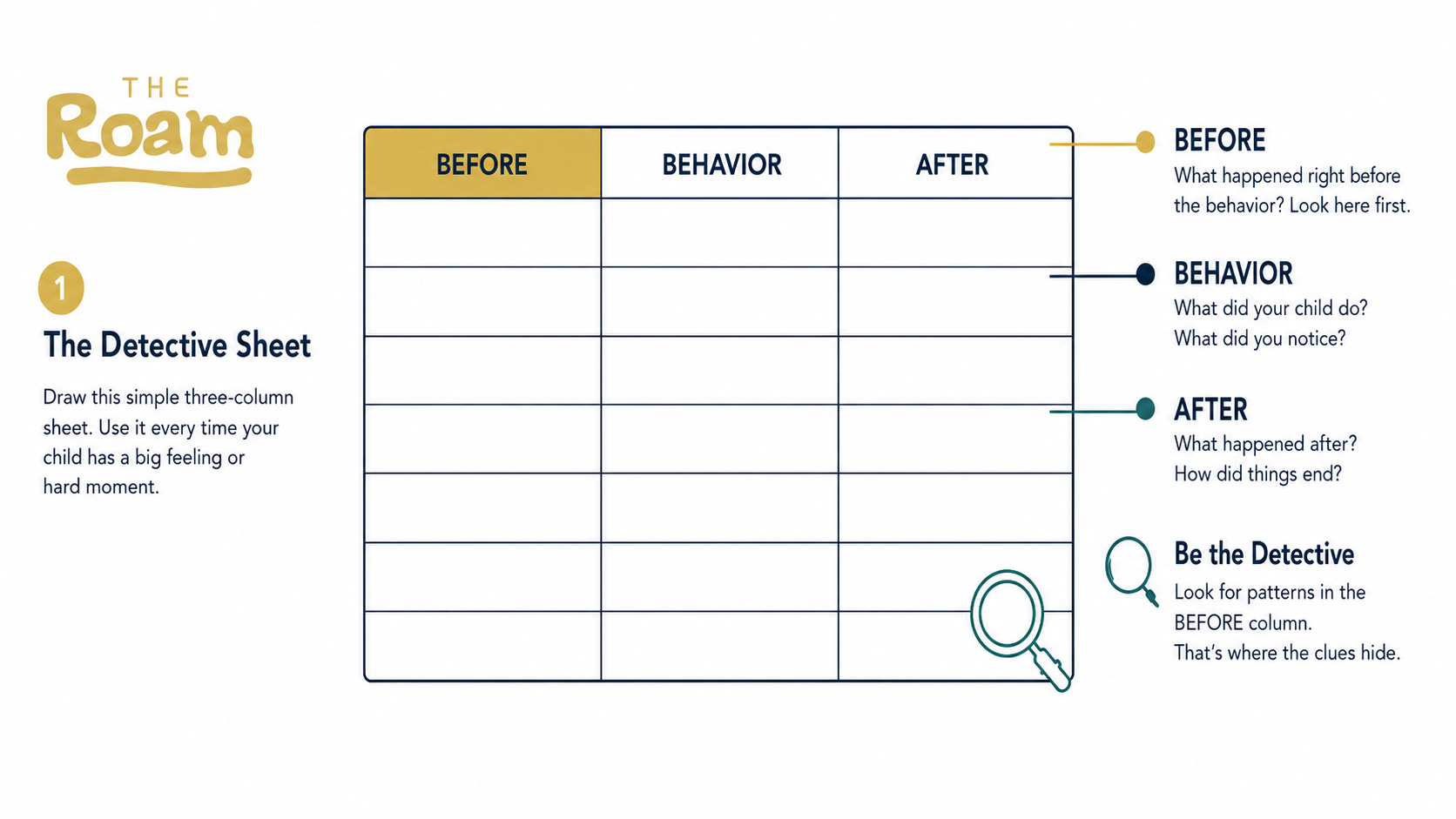
Make three columns.
Draw three columns on the page and label them BEFORE, BEHAVIOR, and AFTER. This is the oldest trick in the book, and it works because the answer almost always hides in the BEFORE column, the part everyone skips.
Log for a week.
For the next several days, each time the behavior happens, write one quick line in each column. What was going on in the ten minutes before. What exactly the child did. What happened right after. Keep it short. You are collecting clues, not writing an essay.
Read only the BEFORE column.
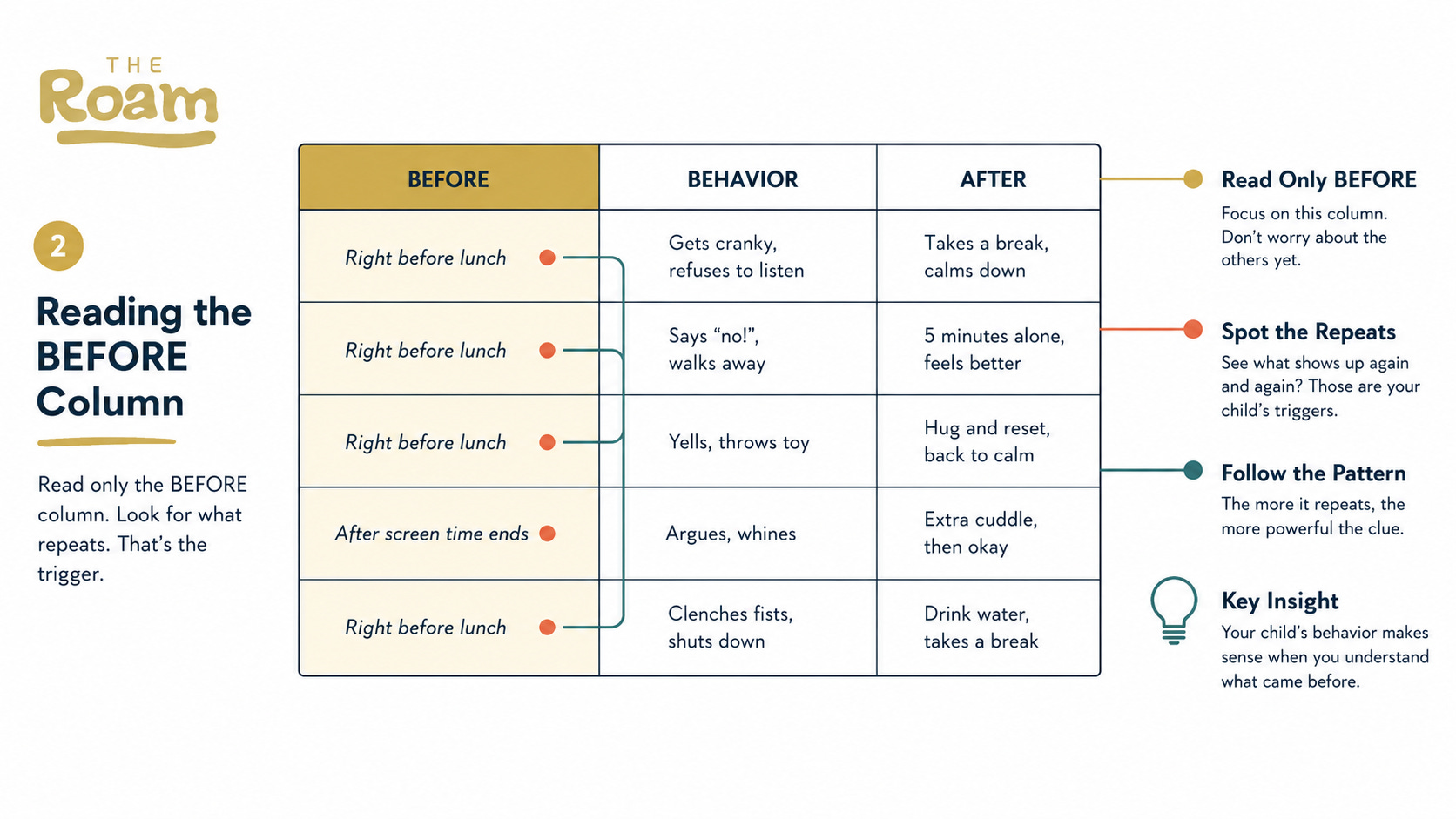
At the end of the week, sit down without your child and read only the BEFORE column. Look for the pattern. Is it always before lunch. Always at a transition. Always after screen time ends. Always when two demands stack at once. The repeating thing in that column is your real suspect, and it is usually not what you assumed on day one.
Change one upstream thing and watch.
Move the snack earlier. Give a five-minute warning before transitions. Add a burst of movement before the hard part of the day. Then keep your sheet going and see if the smoke clears. If it does not, you now have a precise, written record to bring to your doctor, which is exactly what they wish every parent walked in with.
Older kids can run this on themselves, and it is even more powerful when they do. Let a ten-year-old track their own afternoons and find their own pattern. The day a child discovers that their feelings have causes they can actually see is the day they stop being at the mercy of them.
The point is to believe a child makes sense, and to go looking for the why with the same patience you would want someone to bring to you on your worst day. Most kids have never had a single adult do that for them. You can be the one who does.
With Love,
Rache
🤍

Disclaimer: This is not medical, psychological, or diagnostic advice, and it is not a substitute for professional care. If you have concerns about your child’s behavior, development, or wellbeing, please speak with your pediatrician or a qualified clinician. Never start or stop any medication except in partnership with a prescribing professional. Opinions only. substack.com/@rachebrand
References
Mona Delahooke. Beyond Behaviors. PESI Publishing, 2019.
Ross W. Greene. The Explosive Child. Harper, multiple editions.
Gabor Maté. The Myth of Normal. Avery, 2022.
Indiana Resource Center for Autism, Indiana University Bloomington. Observing Behavior Using A-B-C Data.
Sahib S. Khalsa et al. Interoception and Mental Health: A Roadmap. Biological Psychiatry: Cognitive Neuroscience and Neuroimaging, 2018.
The Roam: Belonging to Yourself

We train our kids to scan outward from the moment they can walk. We say these statements without realizing their impact: Is the teacher happy with you? Did you do a good job? Did you make a friend? Did you get it right? Mommy is so happy with you when you do a good job.
What We See is Not the Whole Picture

Here is a piece of biology that takes most people a minute to absorb: You have never once seen reality directly.