

Decode: Sight—Using Holographic Thinking for a Dimensional Life Experience
What if you have never seen the world the way it was meant to be seen and you are truly missing out on the multi-dimensional life experience as it was meant to be explored.


When you see a red apple, what do you see?
Close your eyes for a minute and picture it whole. It is glistening a little, it has a brown stem, and maybe there is a small blemish where the skin dents inward. The apple looks the way you imagined it would, which is the first thing worth noticing, because the picture came from you as much as from the apple.
Start with the red. The apple throws the red back at you. The skin absorbs the rest of the light and returns only that one band, so the color you call the apple is the single wavelength it reflects off of it.
Now go under the skin. There is the flesh, the core, the seeds, and inside each seed the whole tree folded down into a sum of all the parts. Think about it, like that one seed to build a whole orchard.
Behind the apple in time stand the blossom it opened from, the tree that carried it, the graft someone made by hand, the cultivar bred across generations of people choosing for sweetness or more crunch, the soil, the rain, the long season of sun it spent turning light into sugar. Above it move the pollinators that started it and the weather that fed it. In front of it run the hand that picked it, the crate, the truck, the shelf, the price, and the labor of everyone who carried it to you.
So the apple holds the scales above and below it and the time before and after it, folded into one round red object on the counter. That is the whole Sorce Field sent to you through a single object. This is the entire instrument working on something you can hold in one hand.
And the way you could describe it is by seeing only the red and its stem.
You may be missing the entire world around you… for just a moment, could you imagine that? You might actually not want to see more. And that’s okay too, but I am inviting you to learn something today and to share this with your friends, your children and your family.
What you see at face value is just the trickery of linear 3 dimensional field. But if you follow the invitation, I will teach you how you can unpack and decode more of what’s there.
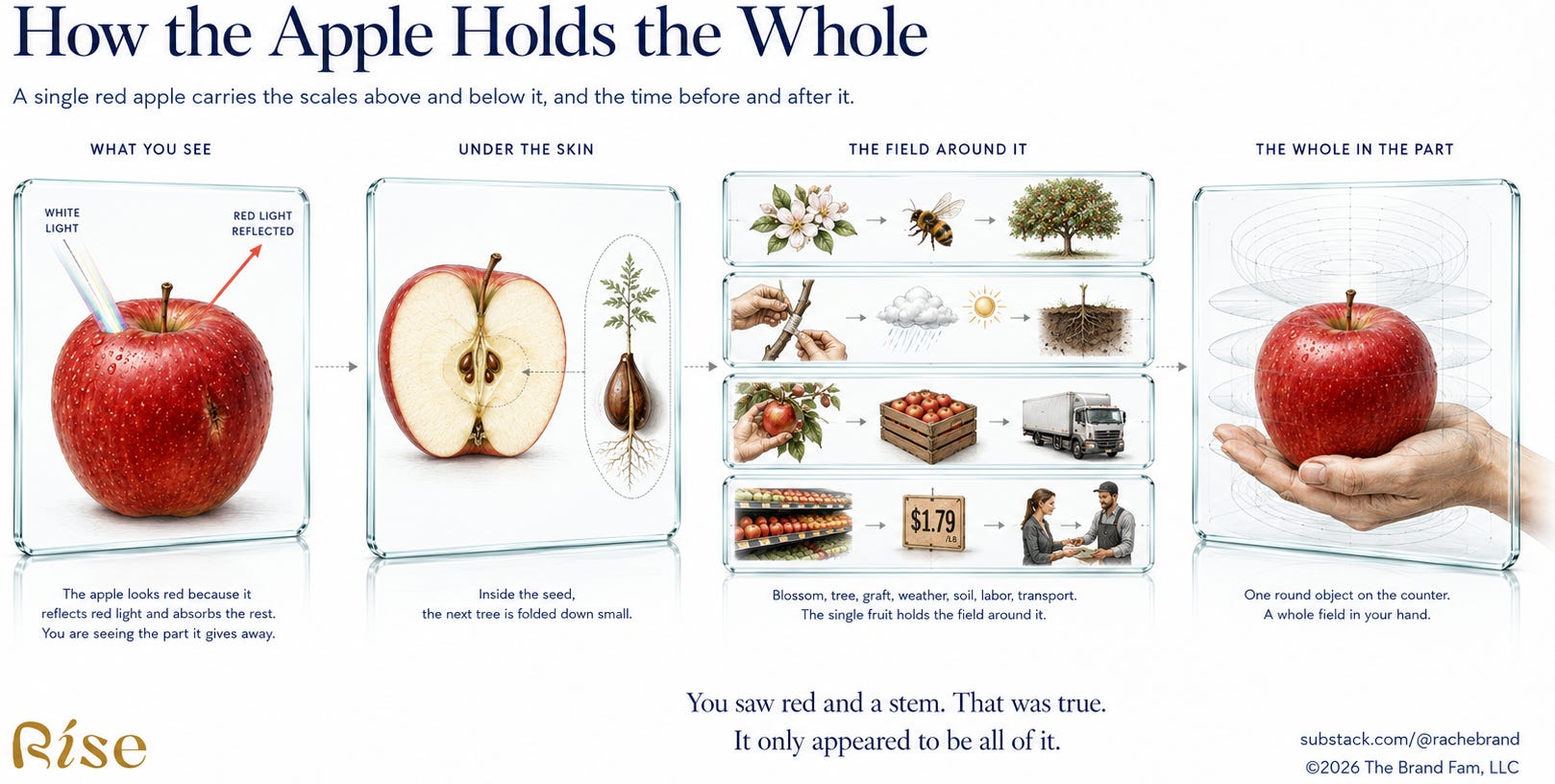
The surface is one layer, and beneath it is infrastructure, set up by the Pattern Atlas formed in nature and then leveraging the past and future and the many layers of the moment. It was built this way, so that understanding anything asks you to dig through the layers to reach something deeper.
This post is a way into a more comprehensive form of sight, and to understand how the dimensions play out as an opportunity to discover.
You See a Reconstruction of the World
Did you know you were seeing just a reconstruction? Or do you think you are seeing what you believe is ‘reality’?
Let’s look at the mechanics first. Light enters the eye, passes through the lens, and lands on the retina upside down and reversed. The retina sends that inverted signal to the visual cortex, and the brain turns it right side up. What you experience as the world is a reconstruction the brain assembles from a thin band of light. The eye is the first lesson in how perception works. You receive a fragment, and you build a whole. This is where the Inversions series began, at the eye, with the world it turns over.
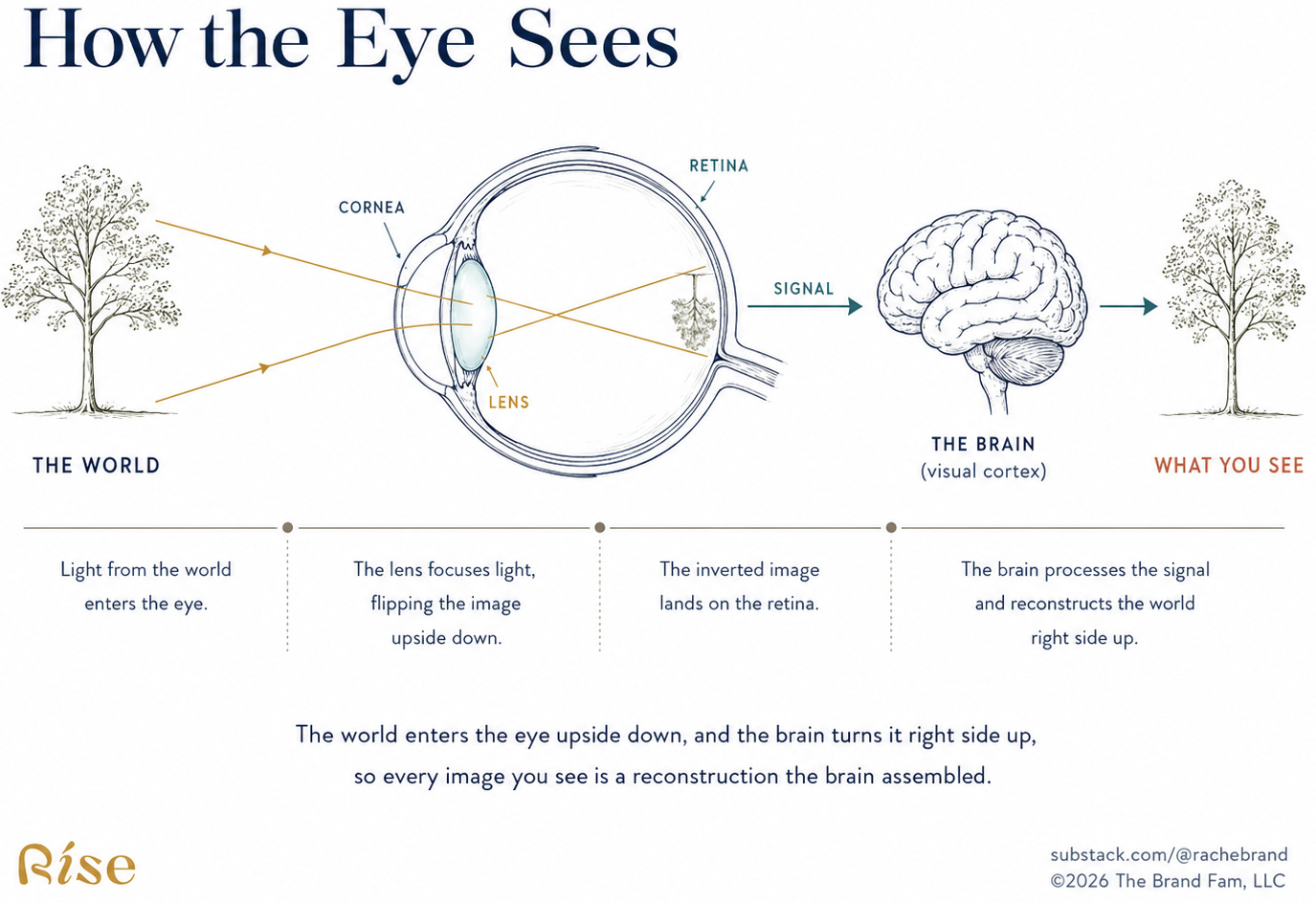
Once you accept that perception is constructive, the next question follows on its own. Reality is stored somewhere underneath the version you see, and a hologram shows how that storage works.
The Whole in Every Part
Cut a photograph, and it breaks into parts. For a Holographic thinker, every piece still holds the whole. Remember when I did Game Theory in the city with the kids, and they saw the trash, and I had actually removed it from my brain? That’s selective sight in the same way. When we can only see the fraction, we make up the world around us as we want it to be. So we create the story and build a world around it. We know it’s there, but we completely assume a world around it.
Cut a portrait in four, and you hold an eye, an ear, a mouth, a collar, each piece carrying its own region and nothing else. A hologram records light differently. The information for the entire scene spreads across the whole plate, so when you cut a hologram in four, each piece still shows the entire image, only dimmer. The whole lives in every part and you are seeing it from various angles in a greater dimension.
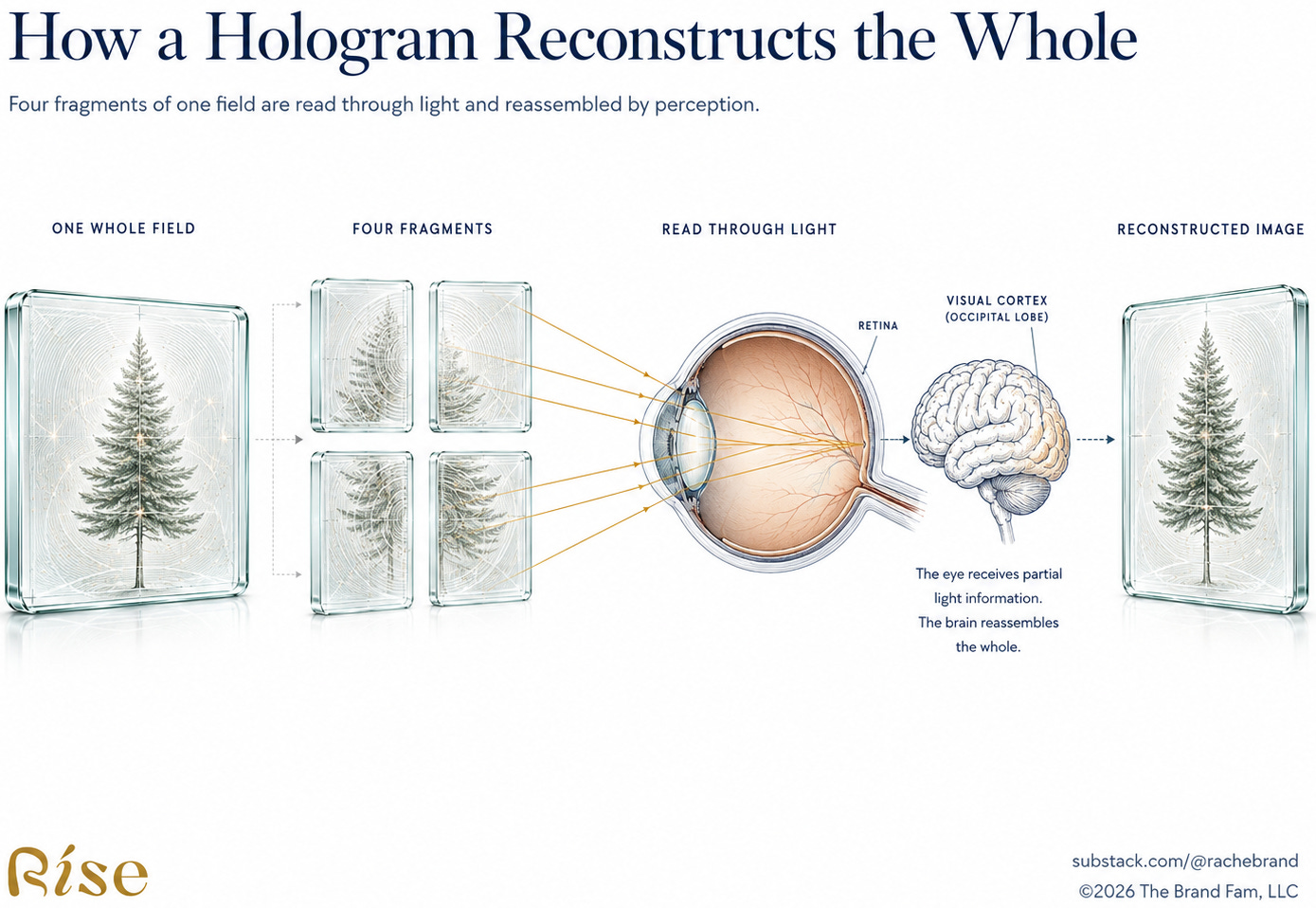
David Bohm called the deep order enfolded in every region of space the implicate order, the whole present in each part rather than assembled from parts. The maxim is older than the physics, and the convergence across the traditions is the evidence. The cell and the cosmos run one code.
How to Think Holographically
I am not certain sight like this can be taught. I can offer you a way into it. I was driving yesterday and working it through with Iza, which is the part of this I love most, the doing of it out loud in the car with my children. A linear person drives inside one or two dimensions. They watch the road ahead and the mirror behind, and the world arrives in the narrow band the eye is pointed at, the thing in front and the thing in the periphery, and very little else.
Here is how I see:
I am reading the topography ahead, the shape of the hill, and underneath the hill the plates that pushed together long enough ago to lift this land into a hill at all.
I am looking inside the restaurants as they pass, reading what the person at the window is feeling, and into the car ahead of me, reading the conversation off the set of two heads.
I am anticipating the next corner, whether a car is coming, what I would do if it were.
I am looking up at the birds that ride the high air and the weather moving in, and the particular way I am connected to the cosmos in this exact minute.
I am holding what the GPS says is ahead and what the road may actually hand me given the state of things.
I am holding the last pings from the news, the local and the global, the gas prices that tell me what the next twenty-four hours expect of us, and I am feeling the other drivers receive that same news through a single flat layer and turn it into rage.
And then there is a child at the side of the road who looks lonely, and the song lifts into something about love, and I remember to tell Iza that I love her, and then to tell her what love is, and what a friendship is for at her age.
All of that is one glance, and it arrives at once. The linear driver and I share the road and the minute, and we live in different worlds. Mine has a floor of deep time under the hill and a ceiling of weather and birds, it carries the felt state of strangers and the mood of a whole country, and it has my daughter in the passenger seat, which is the part that finally matters, the part the entire field was arranged to deliver me to.
The Two Axes
To think holographically is to read any single point as a carrier of the whole system. It moves along two axes at once.
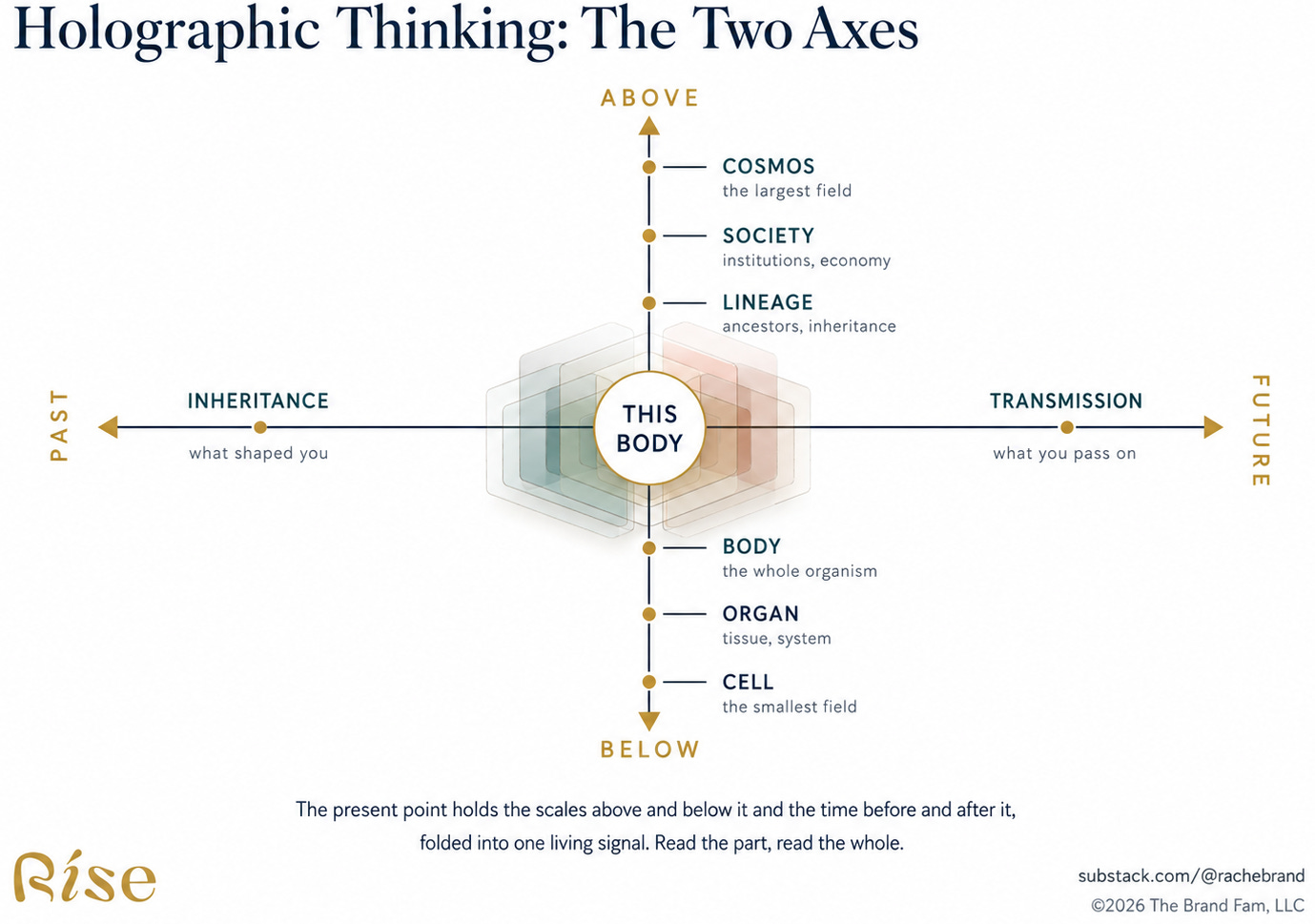
Above and below. One code organizes a cell, a body, a family, a lineage, a society, and a cosmos. What appears at one scale appears at the others, written in the local material. A branching vein, a river delta, and a fractal tree share one logic, and a family’s unmet need and a nation’s unpaid debt compound by the same arithmetic. Learn the pattern at one scale and you recognize it above and below, and a body and a society become one problem read at two sizes.
Past and future. Every point sits inside time. Behind it runs everything it inherited, the cellular record, the lineage, the conditions that shaped it. Ahead of it runs everything it transmits, the children, the work, the field the next generation walks into. A single body in a single moment holds the inheritance behind it and the legacy ahead of it in the same tissue, and reading the present with accuracy reads both directions at once.
Hold the two axes together, and they cross at one place: this body, here, now. That crossing point is the hologram. It folds the scales above and below it and the time before and after it into one living signal.
This is why the work is correct at any scale. The same alignment that moves a body moves a family, and the same distortion that bends a family bends a society. You can enter the whole through any single part, because the part was never separate from the whole. It only appeared that way. That appearance is the illusion.
The Holographic Thinker
Some minds already read this way. They hold the mycelial scale and the cosmic scale and every level between in view at once, and they pick up the whole orbit of a thing rather than its nearest face. Children read like this before training narrows them to one scale at a time. The capacity is native, and the work is to stop suppressing it and to turn it on the parts of life that the single scale keeps hidden.
You Read in Fractions and in Layers
Everyone reads dimensionally already. In a single conversation, you take in the words, the tone, and the body at once, and you assemble meaning from all three. The holographic thinker runs that same reading across every scale. You never see a thing as only itself. You see the body under the surface and the pattern above it in the same glance, and you read the literal layer, the somatic layer, and the cosmic layer together.
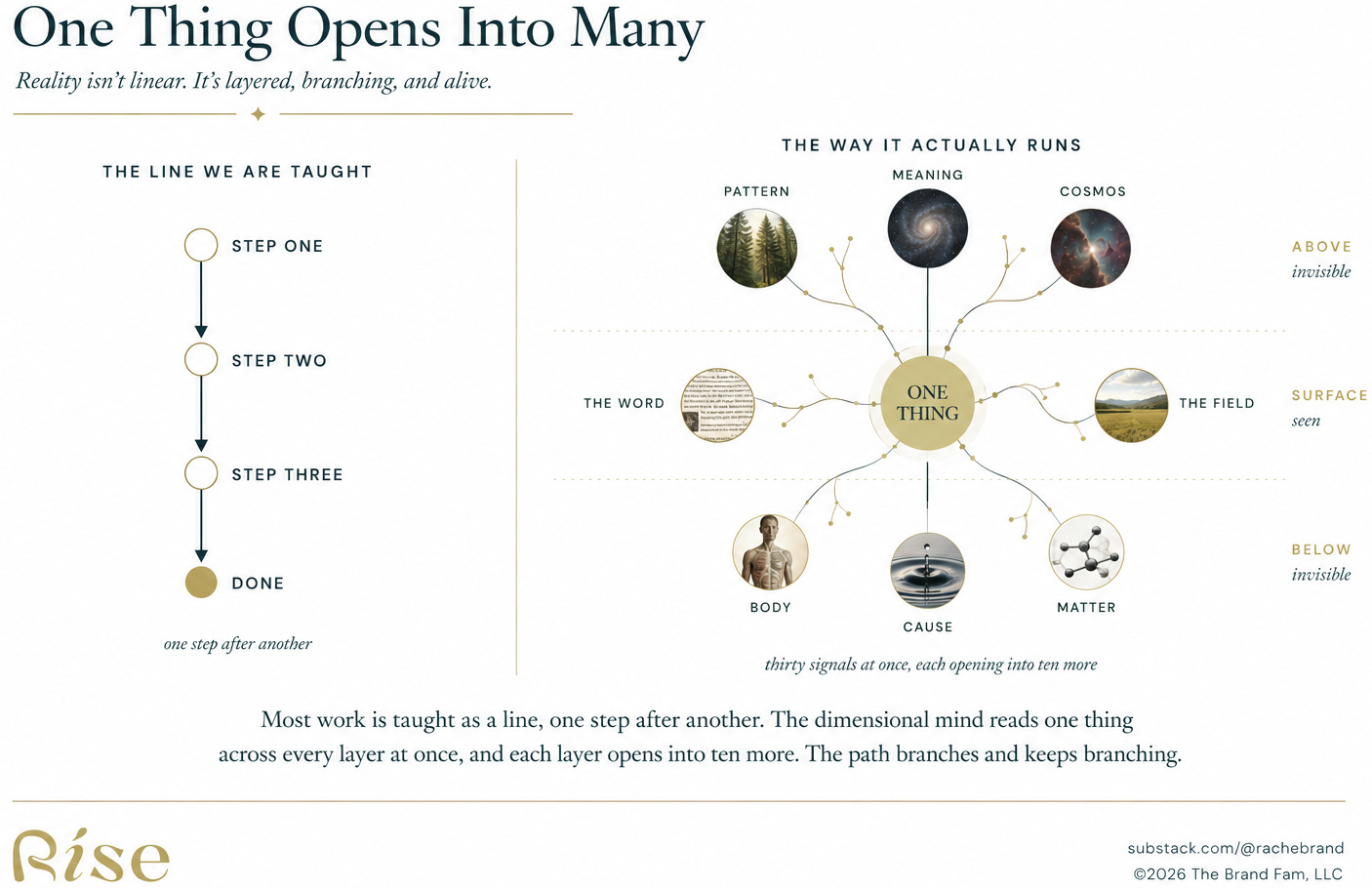
The path this produces branches. You start one thing and the thing opens. To finish the first piece you surface the ten pieces it contains, and each of those opens again. This is the fractal property: the part repeats the structure of the whole, so every part you touch reveals more parts of the same kind. The work takes longer because you are reading thirty signals at once and holding each of them as layered.
Holographic, fractal, and dimensional are three faces of one instrument. Holographic names the principle, the whole present in every part. Fractal names the structure, the pattern repeating as you descend. Dimensional names the perception, the many layers read at once. Together, they describe a mind that reads the whole, the parts inside it, and the levels it spans, in the same moment.
My Cadence
I take far longer than other people to finish a thing, and when I finish, I have finished thirty things at once. I cannot write one article. I write the one, and then I write the three to five pieces underneath it that explain it, because the main piece opens into all of them the moment I touch it. That is the fractal property doing its work, one thing surfacing the ten it contains. It looks slow from the outside. It is the opposite. The cadence is simply different from the linear one, and it is mine.
What This Asks of Us
The eye taught the whole species to reconstruct a world from a fragment of light. Holographic thinking is the same instrument, turned on purpose. Take any single point, read up and down the scale and back and forward through time, and hold all of it together. It disorients at first. Then the frame settles, the readings come faster, and the whole reorganizes around the part.
Read the body, and read the lineage it carries, the society it sits inside, and the legacy it will transmit, from one point of contact, all at once. Remember you are brilliant and you don’t need permission from anyone in the world to do this work. Just you.
“As above, so below. As within, so without.” —The Emerald Tablet, Hermetic tradition
This is old knowledge returning with new proof. The Hermetic tradition named it first, thousands of years ago. Blake saw a world in a grain of sand. Dennis Gabor built the first hologram and gave the principle a physical body, the whole recorded in every fragment of the plate. David Bohm named the implicate order and placed the whole inside each region of space.
My last series began at the eye. In the Inversions work, in the piece on how we see, the world arrives upside down and the brain turns it over, and the cost of that correction is a lifetime spent mistaking the reconstruction for the thing itself. The Inversions named what runs backwards. Holographic thinking names what was always whole underneath the inversion. We are remembering the lens, and holding the part of the record that still reads true.
With Love,
Rache
🤍

Disclaimer: Not to be used as policy, financial, or medical advice. Opinions only. substack.com/@rachebrand
References
THE LINEAGE OF THE IDEA
The Emerald Tablet, Hermetic tradition. The origin of the maxim as above, so below.
William Blake. Auguries of Innocence. Circa 1803. A world seen in a grain of sand.
Dennis Gabor. A New Microscopic Principle. Nature 161, 777-778, 1948. The invention of holography and wavefront reconstruction.
David Bohm. Wholeness and the Implicate Order. Routledge, 1980. The whole enfolded in every region of space.
ON PERCEPTION
Iain McGilchrist The Master and His Emissary. Yale University Press, 2009. On the part-focused and the whole-focused modes of attention.
IN THIS SERIES