

Inversions: Education Trains the Compliance the System Requires
Signal 062. You were taught that school unlocks opportunity. It delivers exactly what it was built to deliver, a body trained to sit, to comply, to forget another frequency was ever available.


You have probably been taught that education is the credential that unlocks opportunity, the structure that prepares young people to function in society and contribute productively to the economy. It is a god-given right, a human right. The architecture of K-12 public schooling, supplemented by private alternatives and capped by the higher-education credentialing system that funnels graduates into the professional workforce, has been treated as the largest and most consequential institutional investment any society can make in its youth, and the United States has been making that investment at roughly $750 billion dollars annually across K-12 alone, with higher education adding another $670 billion in tuition, fees, and public subsidies. The teachers are mostly trying their best. The administrators are mostly trying their best. The parents are mostly trying their best within the framework they were given.
The data underneath the education story is overwhelming. Roughly 9% of American children between the ages of 3-17 have been diagnosed with ADHD as of 2024, up from roughly 6% in 2003, and roughly 6 million of them receive medication for the diagnosis (and depending on your district and age, there is a much greater % like ours here in Connecticut). Pediatric anxiety and depression have climbed continuously since 2010 in lockstep with smartphone adoption. The average American adult under 35 carries roughly $37,000 in student loan debt, with the total federal student loan portfolio now exceeding $1.7 trillion. Standardized test scores have been stagnant or declining across multiple decades despite per-pupil spending increasing in real terms across the same period. The COVID-era learning losses have not been recovered five years out. Teacher attrition is at a historic high. The kids are not thriving. The teachers are not thriving. The parents are not thriving. The institution itself is not thriving.
And this is only the current view.
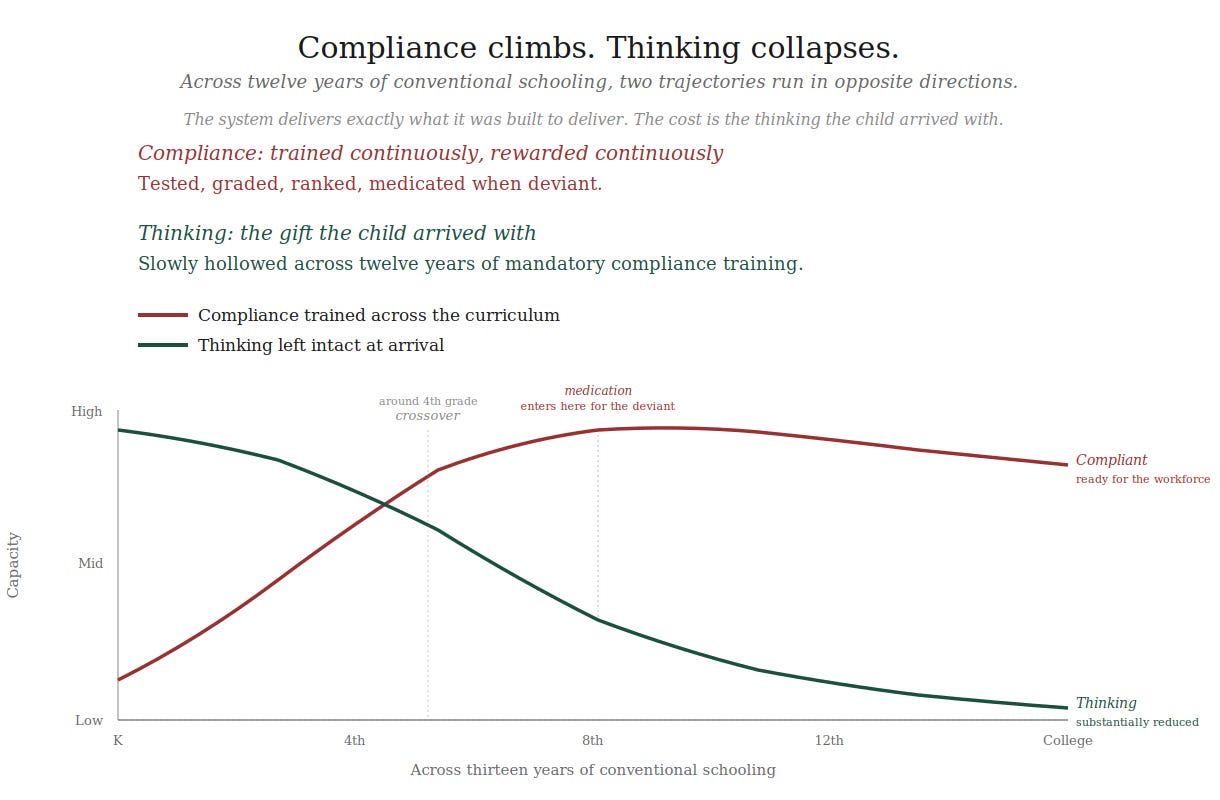
A system that delivers compliance, measures compliance, rewards compliance, and medicates the children whose nervous systems will not produce compliance, while the actual capacity to think, to follow an idea, to refuse a premise, to follow a thread of inquiry across multiple fields without permission, has been quietly hollowed out across the 12 years the system has them. It is reading the symptom as the disease. It has been doing that since the Prussian model of mass compulsory schooling was imported into the United States in the mid-19th century as a deliberate effort to produce workers for the industrial economy and soldiers for the standing armies, and the architecture that was designed for industrial-era objectives is still running today inside an economy that has not been industrial for thirty years. The children are now telling us what that has cost, and the telling has been getting louder for two decades.
What’s Happening Beneath the Surface
Now turn the reading.
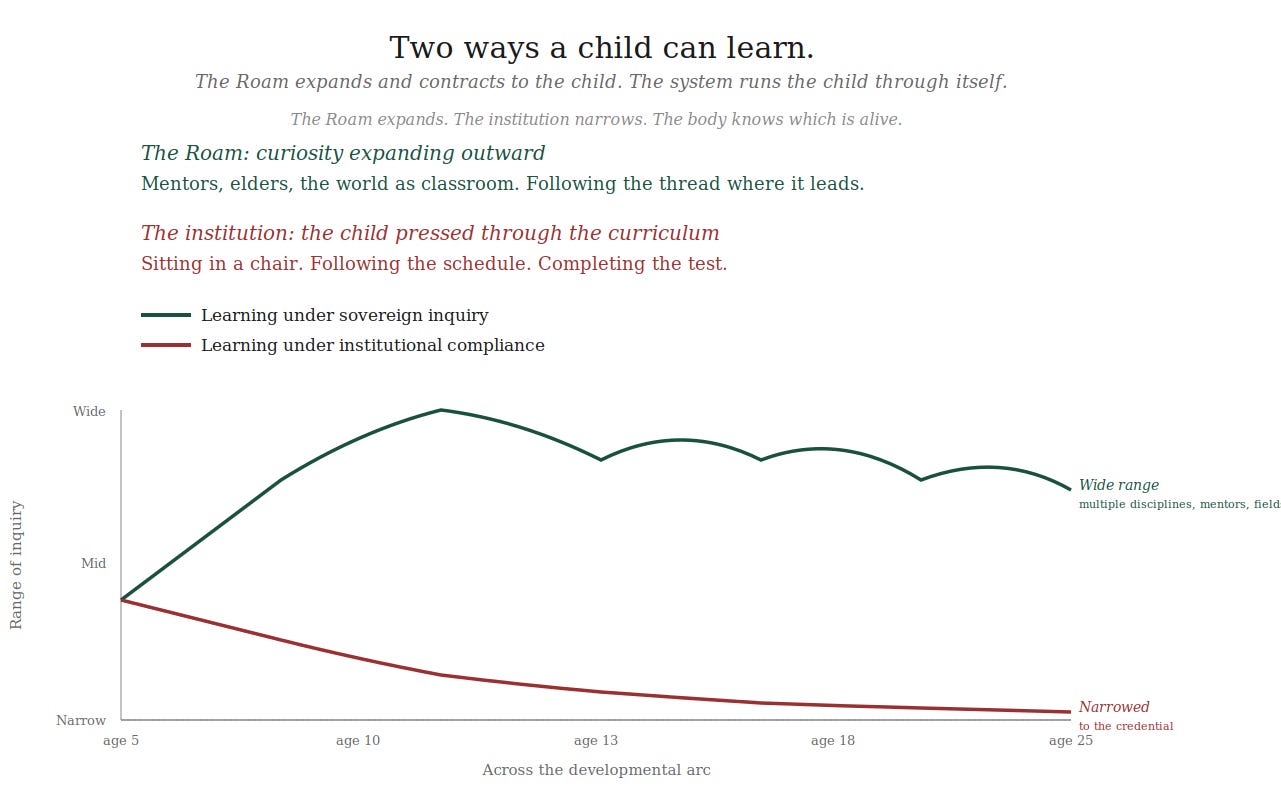
Education is not the delivery of curriculum to a passive child. Education is the relationship between a sovereign body of inquiry and a world that is itself an inquiry, mediated by elders and mentors who have learned to read the body of the child and follow what the child is reaching for. The compliance the system is measuring is not the byproduct of education. The compliance is the actual product the system was designed to produce. The thinking the child arrived with is not a baseline the system can build on. The thinking is the casualty the system is producing every year, in every classroom, in nearly every body that passes through it.
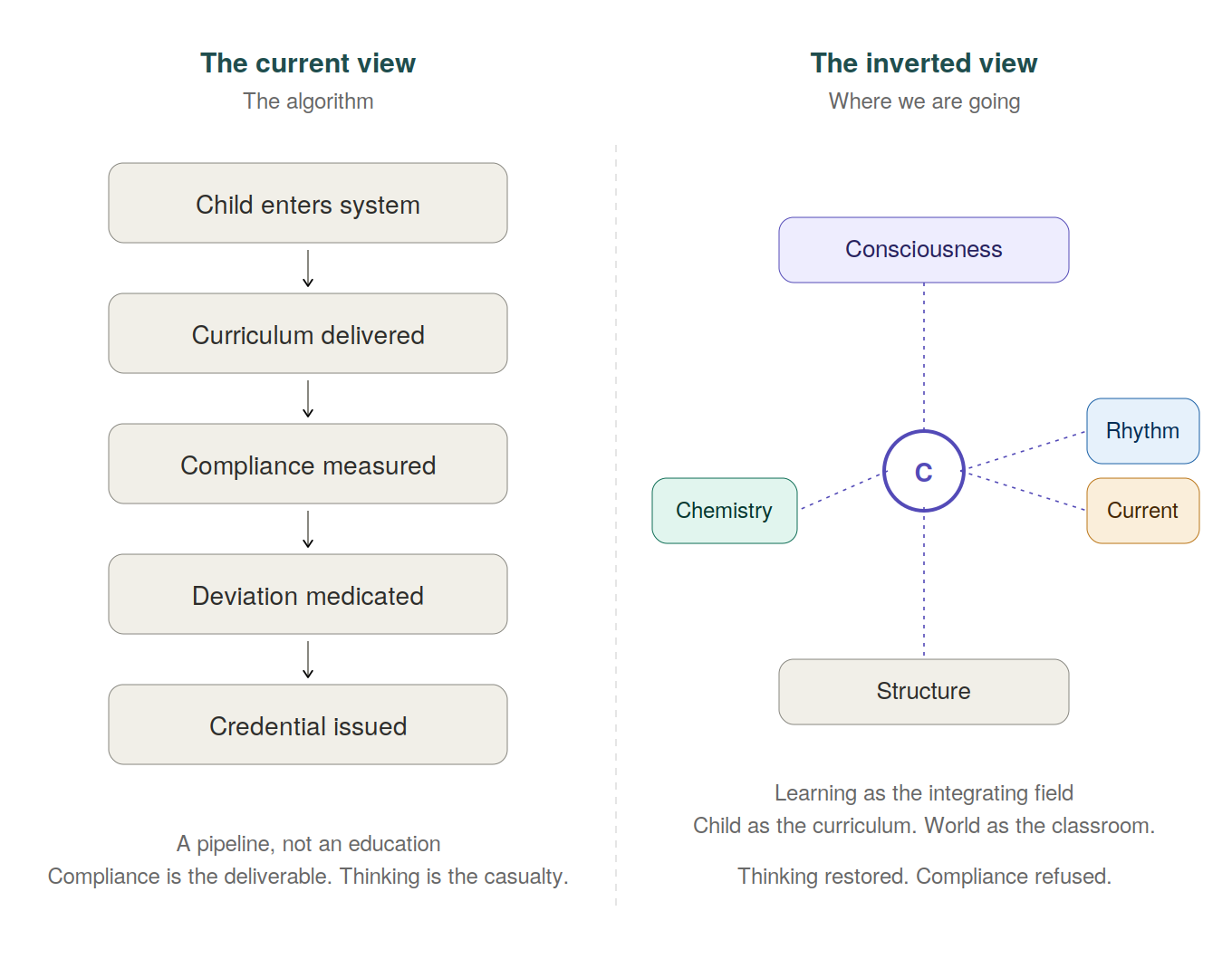
Here is the inversion: The current view treats the child as a body to be shaped by the curriculum into a graduate the workforce can absorb. The inverted view treats the child as the curriculum, with the world serving as the classroom, the mentors and elders serving as the relational field that supports the inquiry, and the credential serving at most as one outcome among many, not the goal the entire architecture is bending toward. The compliance the institution rewards is the suppression of the very capacity that would let the child read the moment they are arriving into and respond to it intelligently.
What’s Happening Overall
Education is built from four things, and the institutional system only addresses one of them.
The child’s inherent knowing, which is what the child arrived with, the gifts the lineage carried forward, the hyper-sensate field the next world requires that Dr. Therese Rowley has been naming through her MultiSensory Intelligence framework, and the deep developmental potential the body carries from the moment of conception. This is the layer the institutional system was never built to hold and that the system has been progressively less able to hold as the developmental field of the arriving children has become more complex.
The curriculum and credential, which is the standards, the tests, the grades, the transcripts, the diplomas, the degrees, the certifications, the rankings, the recommendations, the entire architecture of measurement and validation. This is the only layer the institutional system actually addresses, and the layer that the entire economy of K through 12 and higher education has been organized around, because the credential is the resource the system produces and sells. The credential is not the education. The credential is the receipt the institution issues to demonstrate that the body sat through the years of instruction without leaving.
The relational field, which is the mentors, the elders, the conversations across difference, the community of inquiry, the moment a teacher who knows you sees what you are reaching for and offers you the resource you did not know you needed. Education was always relational before it was institutional, and the practices that produced what we now consider the foundational works of the human intellectual tradition were almost all relational practices, conducted across long apprenticeships between students and teachers who knew each other intimately.
Sovereign thought, which is the capacity to think for yourself, refuse compromise, follow your own knowing even when the institution is telling you to follow its knowing instead. This is the capacity Richard Rudd named in Gene Key 14 as the Gift of Competence and the Siddhi of Bounteousness, with the Shadow of Compromise being the frequency the institutional system has been training into children for twelve years until the body forgets that another frequency was ever available. This is the capacity the system cannot teach and cannot certify because the very fact of certification interferes with the development of the capacity. You cannot be tested on whether you can think for yourself, because the moment the test exists, the thinking is no longer for yourself.
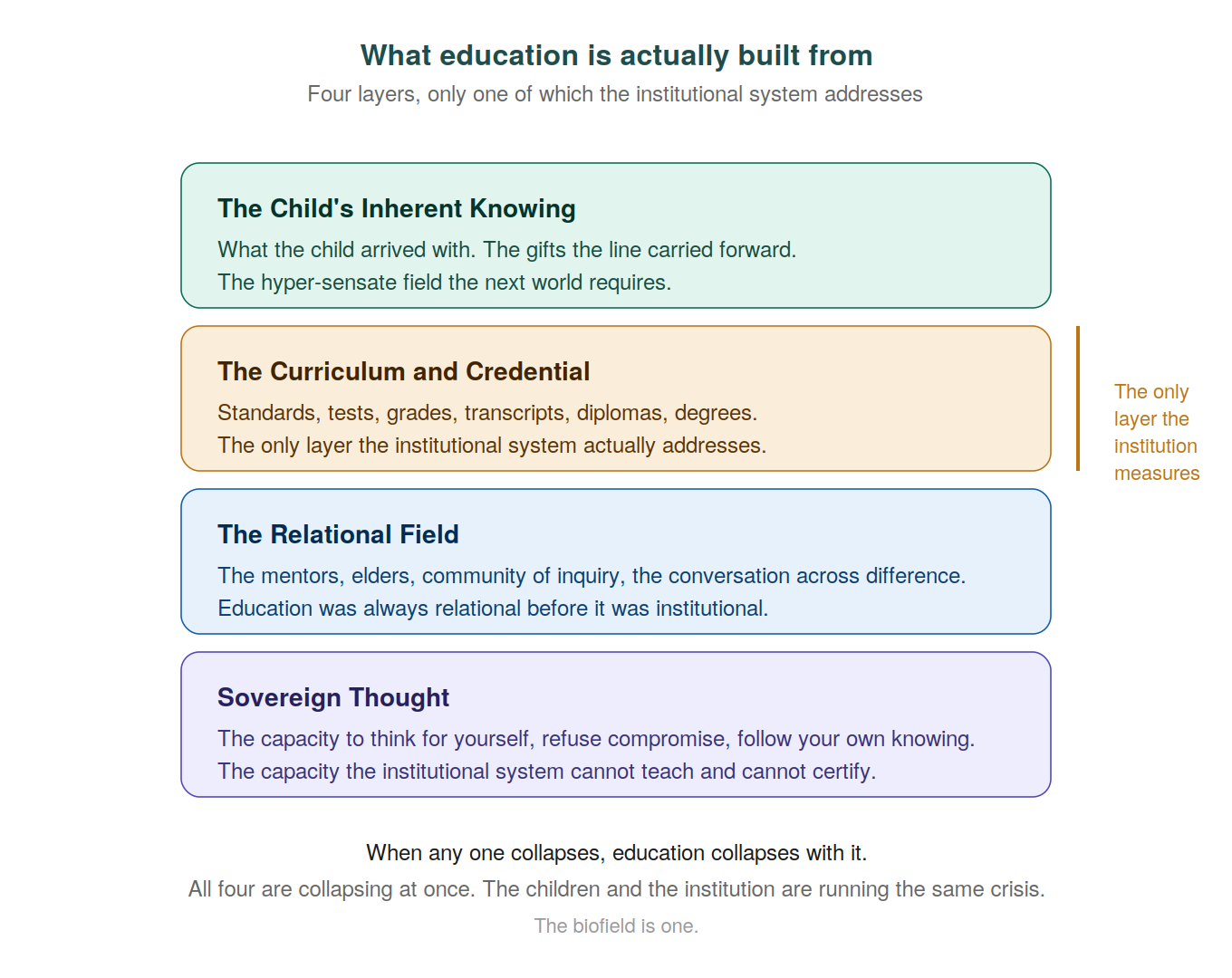
When any one of these collapses, education collapses with it. All four are collapsing at once.
Education Is the Body’s Read of Every Other Domain
The Education Signal sits in a particular place in the broader series because the educational architecture is the architecture that shapes how every body in the country reads every other domain. The relationship a young person develops with their own capacity to think during the twelve to sixteen years they spend in school is the relationship they will carry into how they read the climate, how they read the political moment, how they read their own bodies, how they read the food they are buying, how they read their relationships, how they read the news, how they read the inheritance their lineage handed them. The system that produces compliant graduates is producing the same compliance that the food industry then exploits, that the pharmaceutical industry then exploits, that the political system then exploits, that the financial system then exploits, that the wellness industry then exploits. The biofield is one. The compliance trained at the kindergarten level is the compliance that the seventy-year-old retiree is still running when she takes the medication her doctor prescribed without asking whether the medication is what her body actually needs.
This is why the education work matters more than almost any other work in the series. The integration that any individual reader does after reading this series will land twice as hard in their children as it lands in themselves, because their children are still inside the developmental window when the architecture of thinking is being formed. The work of raising children who can think is the work of refusing the system that produces compliance and building, in real time, the alternative the children deserve.
My Experience & What I Witnessed
I want to write to you now about my own arc through the educational and medical systems, because the arc explains the diagnosis I am now able to make, and the diagnosis is the reason I am building what I am building with my own children.
I spent most of my childhood and early adulthood on medication. I lost myself to Big Pharma for a quarter of a century. The medications I was prescribed across that period were intended, by the doctors who prescribed them and the parents who consented to them, to make me functional inside the educational and social systems I was inside of. The medications did not make me well. The medications made me compliant. The body that was telling me, continuously and at every level of every system I moved through, that something was deeply wrong with how I was being asked to live, was the body the medication suppressed so that I could continue to be inside those systems without disrupting them. The disruption was the signal. The signal was what should have been listened to. The medication was the cover-up the system had available.
I went to boarding school, then to college, then through the standard credential pipeline of the high-functioning American professional class. I picked up a series of credentials, eventually attending the Maryland Institute College of Art, MICA, for graduate work. When people ask me why I went to MICA after the conventional credentialing arc I had already completed, the answer I have come to is this. I went to MICA to learn how to think, because you do not learn that in a normal institutional college. A normal institutional college gives you the tools to persevere in the world you live in. MICA, and art school more broadly, is one of the few remaining institutional spaces in which thinking itself is the curriculum rather than the persistence. The painting class is not teaching you to paint. The painting class is teaching you to see, to refuse the first answer, to sit with what is not yet resolved, to make decisions without external validation, to follow a thread of inquiry across multiple disciplines without permission. Those are the capacities the standard credentialing economy strips out across the twelve years of K through 12 and the four years of undergraduate study, and those are the capacities the work I do now requires me to have. The credential I got at MICA is not what mattered. The reorganization of how I think, which MICA made possible because MICA’s faculty did not require compliance and did not punish refusal, is what mattered.
Homeschool found me. I want to write about that arc carefully because the arc shows what the institutional system was unable to hold and what became available the moment we left.
I have written about the daily container we built for the children at length in the published piece The Roam Learning Lab, and if you have not read it yet I would ask you to read it now, because the witness account of how we have actually structured the learning over the last several months does work in that piece that I am not going to repeat here. What I want to add in this Signal is what the arc looked like before The Roam was built, and what the structural diagnosis of the conventional system looked like from inside our family.
Iza came first. Iza was the kid I felt I could not stand inside myself any longer keeping inside the system that was producing the small wounds I could see arriving in her body. I pulled her out. Then one day Zai said to me, I hate school mom, I am not myself, and my teacher does not want to hear what I have to say, and I do not agree with her. The two months of transition for both of them was the most painful period of my recent life, because I was holding the kids through the unwinding of everything they thought school was supposed to be, while I was also holding my own grief about the years they had already spent inside the architecture that was not going to be able to hold them. The feeling was a little like being stuck. I now know it is called inertia.
Once we were on the other side of the transition, what arrived was different from anything I had expected. We started with diving into big topics. Perception of reality, individual and individuation, the collective, Game theory, consumption and cannibalism. Each month gave us a frame that the kids could carry as a through-line across language, writing, reading, religion, philosophy, art, math, chemistry, physics, biology, health, history, government, geography, and systems. The container itself, which we eventually named The Roam, is the practice of moving the learning through the world rather than confining it to a room. The kids learn in the studio, in the woods, at Whole Foods running the weekly math project against the actual grocery receipt, on hikes with Two Coyotes, in calls with friends about a weird-thing-to-know question, in figure drawing with RISD, in shop projects with Kurt, in travel with me. The container is the world.
The hardest part of the transition has been the loneliness. The kids are so engaged in what they are doing that they do not have a lot of interest in friends in the way the conventional age-segregated school system expected them to. This produces a kind of grief, especially for parents who have been trained to see peer-group socialization as the marker of a healthy child. I have come to disagree with the premise. Peer-group socialization at age-segregated levels is a relatively recent invention in the long history of how humans have raised children, and the older traditions all included extensive intergenerational mentorship, mixed-age learning communities, and significant time spent alone or in small intimate groups. The kids we are raising are reaching for the older model. The institutional model is what produces the friend-group crisis that the institutional model then markets services to address.
Iza and Zai are both now taking classes at colleges, MIT and RISD. They are getting experiences by being in community and relation to other students in adult learning settings, and they are learning from kids in those classes who are several years older than they are. They are also starting businesses, diving into their crafts, joining a festival this summer where they will share their brands with the world. The college counselor I consulted suggested I keep a curriculum and grade their performance and track it, so that when the time comes to apply to college, I will have a robust record to share with whatever institution they want to attend. The track record will be a differentiator. The actual education will not have come from the track record. The track record will be the receipt I issue to demonstrate that the work happened, the way the conventional institution issues a transcript.
The Hyper-Sensate Generation Cannot Be Held by the Old Architecture
The deeper recognition I have come to across the last few years is that the architecture the institutional system was designed for is not the architecture the children are now arriving with. The children Dr. Therese Rowley describes through MultiSensory Intelligence are arriving with nervous systems the next evolution requires, and the systems built for the previous version of the nervous system are dysregulating them at a structural level. The system cannot accommodate the children, so the system medicates the children. The medication is the response of an institution that cannot adapt to what is arriving in it. The medication is also what made me functional inside the same architecture twenty-five years ago, which is to say the dysregulation is not new and the medical response is not new. What is new is the rate at which the dysregulation is arriving and the rate at which the medication is being prescribed in response.
The Two Coyotes children I described in the Nervous System Signal are not what most people would call kind in the conventional sense of the word. They are more honest than the kids in the conventional schools. They are figuring out what they actually believe and what they actually want and what they actually feel in the field around them. Kindness in the marketed culture sense usually means living in someone else’s truth, prioritizing the comfort of the other person above your own knowing, which is the compromise frequency Richard Rudd named in Gene Key 14. The Two Coyotes children are not doing that. They are sometimes rigid, sometimes angry, sometimes blunt in ways that adults find uncomfortable, and what they are doing inside the rigidity and the anger is the early formation of a generation that will not compromise the way their parents and grandparents have. The behavior looks unkind from outside. From inside it is the early formation of the gift that the institutional system would have been trying to medicate them out of.
And the kids in the conventional schools are increasingly compliant and increasingly unable to think. They are getting good grades on the tests that the system has designed to measure compliance, and they are arriving in college unable to read a long argument, unable to write a paragraph without an algorithm, unable to sit with a difficult question without reaching for a substance or a screen. This is not the fault of the children. This is what the system was built to produce. The children are doing exactly what the system is asking them to do. The system is asking the wrong thing of them.
What the Experts are Saying
The lineages converge.
John Taylor Gatto, who taught for twenty-six years in the New York City public schools and was named the state’s Teacher of the Year three times before resigning to publish Dumbing Us Down in 1992, made the structural argument with more clarity than almost anyone since. Gatto’s claim, which the subsequent thirty years have only reinforced, is that the school system in its current form was designed in the early twentieth century by industrialists and educators working together to produce a population trained for the factory and the standing army. The curriculum’s hidden purpose is not academic. The curriculum’s hidden purpose is the production of obedient workers, predictable consumers, and politically disengaged citizens. His later work, The Underground History of American Education, walks the historical record in detail. Gatto died in 2018. His diagnosis has not been refuted. It has been ignored.
Ivan Illich’s Deschooling Society, published in 1971, made the same argument from the philosophical and theological direction. Schools, in Illich’s framing, are a relatively recent invention that has crowded out the older traditions of learning that humans developed across the previous several thousand years, and the social damage produced by institutional schooling is significantly larger than the social benefit. Peter Gray’s Free to Learn extended this work into a contemporary developmental psychology framework. Alfie Kohn’s Punished by Rewards demonstrated that the entire grade and reward architecture of conventional schooling produces worse learning outcomes, not better ones. The literature is extensive and converges on the same diagnosis.
The hyper-sensate children Dr. Therese Rowley is naming through her MultiSensory Intelligence work and through The Wonder Children community are arriving in bodies the institutional system was not built to hold. The behaviors that get labeled ADHD, autism spectrum, sensory processing disorder, oppositional defiant disorder, and a dozen other categories are, in Dr. Rowley’s framework, often the surface presentations of children whose nervous systems are calibrated for a different perceptual reality than the one the current institutional system was designed around. Her foundation and her parent-facing community at thewonderchildren.com is one of the few places parents can take an assessment of their own child against this framework, and the framework gives the parent a different vocabulary than the diagnostic categories the medical system would otherwise hand them. I am a writer in support of her work, and the framework she has built has shaped the way I read what is happening to children inside the conventional system.
Richard Rudd’s Gene Keys provides the developmental framework I have referenced throughout this series. Gene Key 14, Radiating Prosperity, with its Shadow of Compromise and its Gift of Competence and its Siddhi of Bounteousness, is the framework that organizes the homeschool decision. Richard Rudd writes specifically that schools tend to homogenize children, treating them as a single collective body that needs to be educated rather than treating each individual differently. He calls compromise the frequency of the whole of humanity. He says it is bred into us through society’s systems and the compromise to our souls’ work becomes the expectation society tells us we need to lean into in order to live this life with others. It is an agreement to settle for less than we came here to do. The institutional school system is the delivery mechanism for the Shadow, training twelve years of compromise into a child’s body until the body forgets that another frequency was ever available.
“I probably could have gone anywhere, but I went to a specific College to learn how to think. In a normal institutional college, which is only giving you the tools to persevere in the world you live in.” — Rache Brand
Educational Events, Cover-Ups, and Chronic Conditions
These tables are also available as a downloadable Excel file for readers who want to work with them directly. The link is in the references section at the end of this Signal.
Every event the medical system or the school system calls a behavioral problem is the body of the child completing a renewal it was forbidden to run at smaller scale. The signal is the event. The event is the medicine we need to look at.
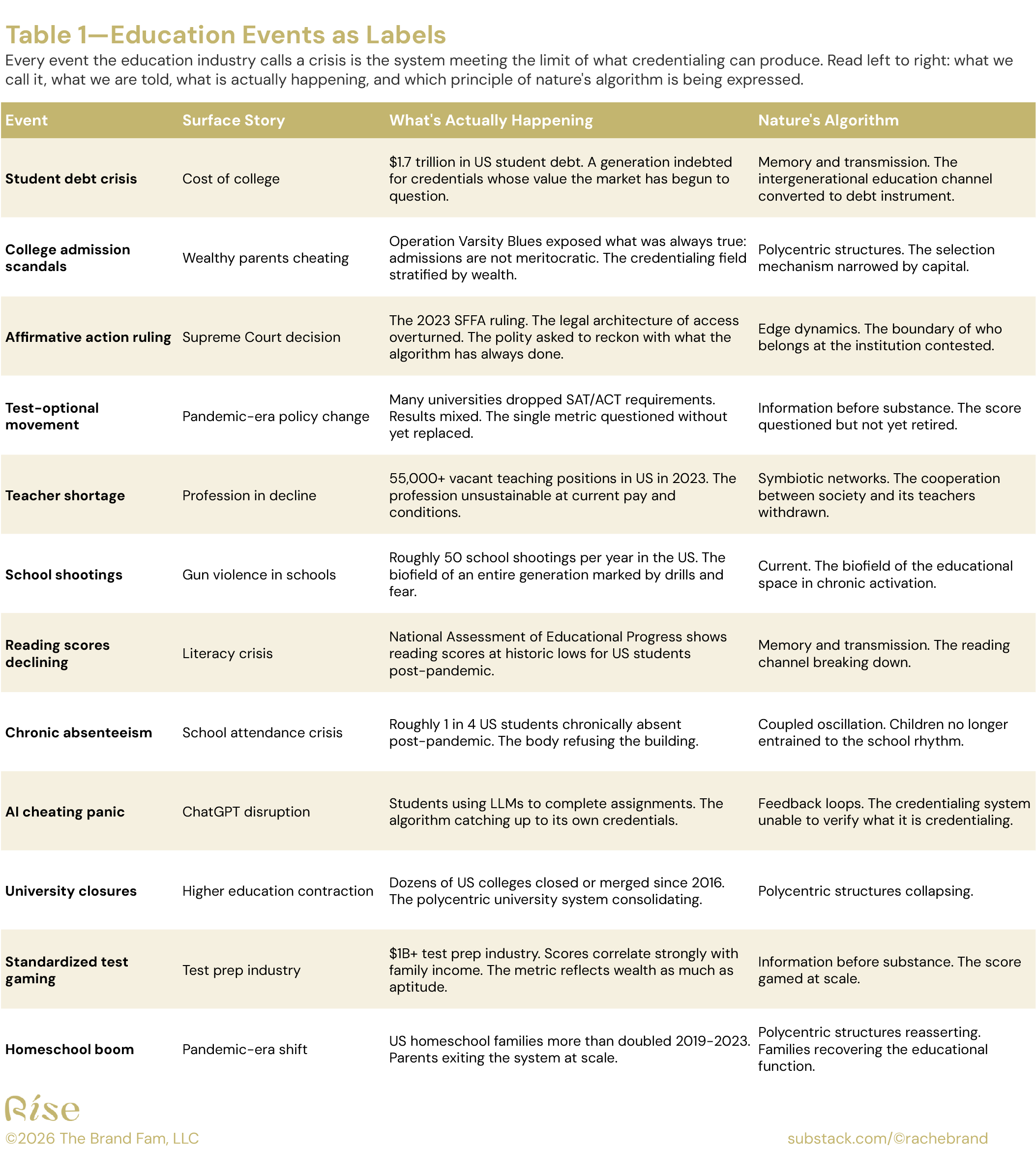
For every signal the child sends about what the system is not delivering, the modern architecture has built an intervention designed to silence it. The ADHD medication. The standardized test that scores the compliance. The honor roll that rewards the suppression. The college admission that requires four more years of the same pattern.
