

Inversions: Your Emotions Are Directions, Not Problems
Signal 067. You were taught your feelings are symptoms to fix or moods to manage. Each emotion is a direction. Anxiety, grief, anger, shame, each one points at something exact. Follow the thread.


The Indicator You Were Taught To Mistrust
The emotional system is the indicator that most people are taught to mistrust the most. We are trained from a very young age to manage our feelings, to perform the acceptable ones, to suppress the uncomfortable ones, and to medicate the ones that refuse to stay quiet. The architecture of modern mental health care, the cultural messaging from the wellness industry, the social training that begins in kindergarten, and the pharmaceutical pipeline that catches everything the first three could not silence are all running on the same premise. The premise is that the feeling is the problem, and the work is to make the feeling go away.
This Signal runs the opposite premise. Each emotion is a direction. The feeling is the body pointing at something exact, and reading it is how you find your way. Anxiety is not a malfunction to be managed. Anxiety is the body’s recognition that you are about to walk into something the body knows is not safe. Grief is not a depression to be treated. Grief is the body’s weight registering what was lost. Anger is not aggression to be cooled. Anger is the sorrow underneath that has nowhere to go. Each of the seventeen states this Signal will name carries a direction. The feeling was never the problem. Ignoring it was.
What’s Happening
The data on the emotional state of the American population is overwhelming. Roughly one in eight American adults takes an antidepressant medication. The figure has more than doubled since the year 2000. Anxiety disorders are now the most commonly diagnosed mental health condition in the country, affecting approximately forty million adults. Adolescent depression and anxiety have risen continuously since 2010, in lockstep with smartphone adoption and the architecture of social media. The wellness industry has built a $6.8 trillion global market substantially on the promise of managing what the population is feeling. The therapy market has expanded to encompass an estimated forty million Americans currently in some form of treatment. The mindfulness app market alone is now worth several billion dollars annually.
And the population is not feeling better. The medications and the apps and the therapy hours and the wellness products are being delivered at unprecedented scale, and the underlying emotional dysregulation continues to grow. This is not because the practitioners are not trying. This is because the architecture itself is built on the wrong premise.
And this is only the current view.
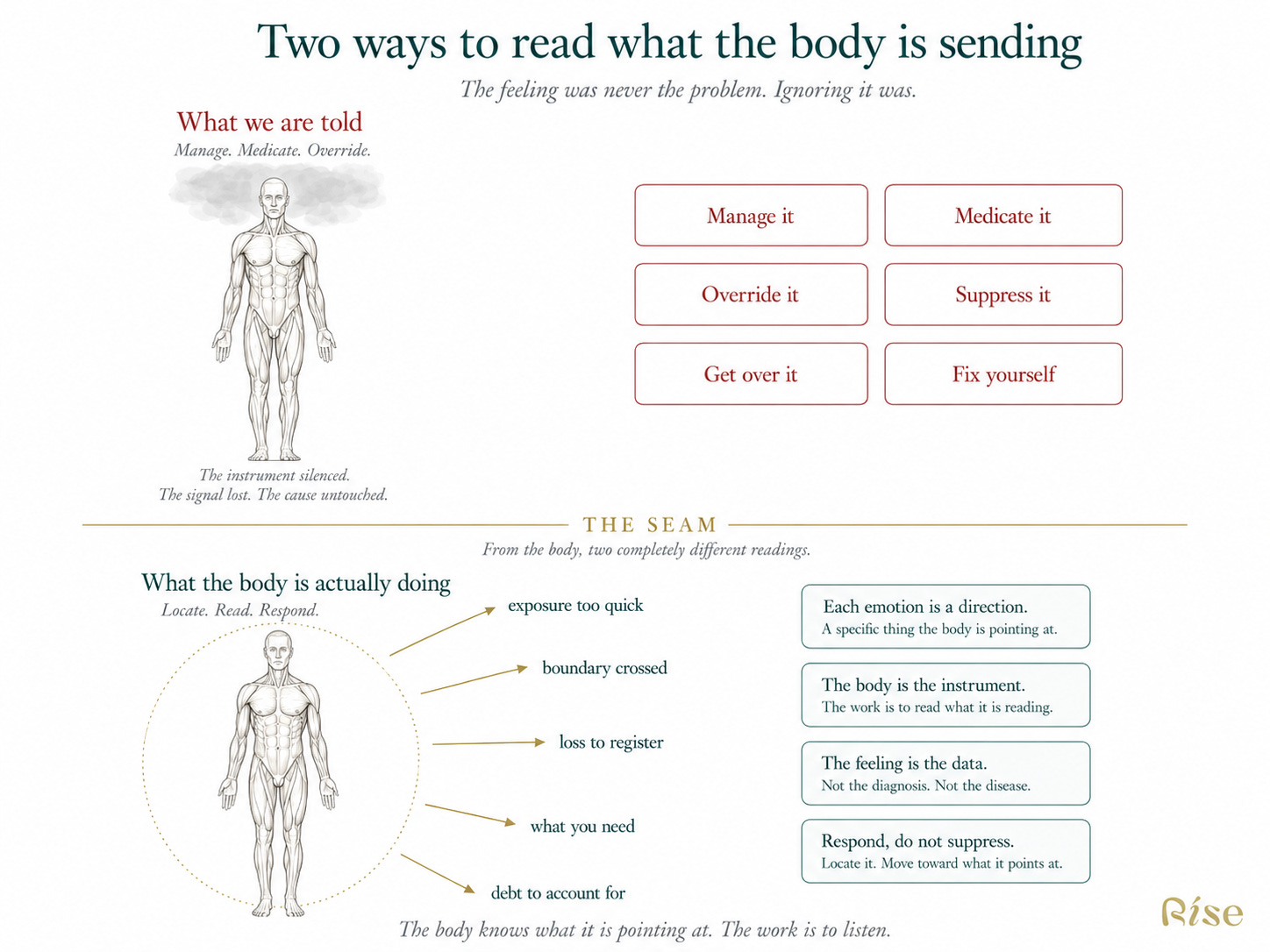
What’s Happening Beneath the Surface
Now turn the reading.
The emotions are not the problem. The emotions are the body’s most precise instrument for telling you what is actually happening inside the conditions of your life. When anxiety rises, the body is reporting a real reading of the environment, the relationship, the choice on the table, the path being walked. When grief arrives, the body is registering an actual loss, often one the conscious mind has not yet named. When anger surfaces, the body is naming a boundary that has been crossed. When shame floods, the body is identifying an exposure that needs to be either acknowledged or refused. Each state carries information the conscious mind does not have direct access to, and the body’s language is the only language in which that information arrives.
The current view treats the emotions as internal weather to be managed, regulated, or pharmaceutically suppressed. The inverted view treats the emotions as the body’s most articulate diagnostic system, sending continuous information about what is happening at every layer of a life. The feeling is not the storm. The feeling is the instrument reading the storm. Break the instrument, suppress the instrument, medicate the instrument, and you do not get rid of the storm. You only lose your ability to read it.

Emotions Are The Curriculum, Not The Choice
I want to spend a moment on the deeper question this Signal points to: whether we choose our emotions or the emotions choose us. The standard cultural framing in this country leans heavily on personal responsibility, which is the framing that says you can choose how you feel, you can think your way into a better mood, and you can manage your reactions through discipline and practice. The framing has produced a generation of people who believe they have failed when difficult emotions arise, because those emotions are read as evidence of insufficient personal work.
I do not believe we choose our emotions. I believe emotions are the curriculum. They arrive because the body is being moved through an arc of experience that requires it to feel what it feels in order to learn what the arc was designed to teach. The jealousy that arises in a high school relationship is not a character flaw. Jealousy is the chemistry the body needs to feel and metabolize so that in twenty-five years, when the next bond shows up under different conditions, the body knows what jealousy is and where it leads and how to recognize when the work has already been done. The grief that lands when a parent dies is not a depression to be treated. The grief is the body learning what loss feels like at this scale, building the architecture that will let the body hold the next loss with more grace and less collapse. The shame that surfaces when you are exposed is not a character defect. The shame is the body’s training in what it means to be seen, and the work is to let yourself be seen without collapsing.
Free will is real at a certain layer, which is the layer of what you do with what arrives. The arrival is not chosen. The response is.

The High School Curriculum
Let me make this concrete with one arc, because the diagnostic only lands when you can see it run through a single life.
When I was fifteen, my French teacher made me the study partner of a boy I could not stand. His name was Chris Catalini. Mademoiselle Luisi deliberately paired us because she wanted me to work through whatever I was working through emotionally with him as the iconography. Over five months, from November to April, we figured out how to communicate. And finally, one day we figured out how to work together. Then we became friends, and I want to use the chemistry metaphor on purpose, because what was happening was chemical. Two compounds, kept apart by the social structure of the high school, brought into proximity by a teacher acting as catalyst, and what eventually formed between us was a bond that neither one of us had any framework for understanding.
I was already in a long-term relationship with a kid in Boston. We had been together since I was thirteen and it was a protective mechanism. It kept me out of a lot of trouble and gave me a frame to fall back on. Actually all of my life I have used boys / men as opportunities to keep me protected from the magnetic energy I would receive from every walk of life, mostly men, and mostly older. It also meant that when something started forming with Chris, he had to take something that was not technically his. The first feeling that arrived was guilt, because I had been trying to set Chris up with a new transfer student. The setup did not work. What worked instead was the bond between Chris and me, and when it arrived, it arrived as a voltage I had not previously experienced… ever.
That summer, I went to Alaska for SCA and grubbed the historic Iditarod trail. I came home different, and the version of me that came home found that everything in my life was wrong. The relationship with Chris was a hard one to end in summer because we shared a similar summer house in Canada and were meant to both be there. So when we were both heading back to boarding school in Pennsylvania, we came together early and tried to work through it. His room was in the same dorm as one of my super buddies, Flynn, and within the first weeks of that school year, Flynn had become the new molecule in Chris’s orbit. I felt it instantly. I was no longer needed in either friendship. I had been replaced, as a structural element in both relationships, by someone who showed me love. I was still unwilling to architect my life around on my own. We call it “someone who showed me love,” but now I know better.
Then anger started coming through. There was a girl in Chris’s Spanish class, blonde hair, always flirting, and other people kept telling me about it the way teenagers tattle, and every time I heard about it, my stomach turned, and rage flooded me. I cannot even remember her last name now. I think it was Becky. The rage was not really about Becky. The rage was about the recognition that the bond I thought was mine was actually a relationship that included other people, whether I liked it or not. The boundary I had imagined was not where I thought it was.
I invented a math problem, well to be fair I really actually needed the help, but I could have worked harder on my own and with anyone… I told my teacher I needed help with the problem, which allowed me to spend my evenings in the dorm next to Chris and Flynn, where I could be near both of them. The teacher who tutored me was a first-year hire, so it made it easy to manipulate. I now recognize that the entire architecture I was constructing was the body’s attempt to stay close to the chemistry it was being separated from. Catalini and I were fighting like animals all that year. Long fights for hours. Then we would make up, and the chemical release would let us stay bonded for another few weeks until the next collapse.
Chris broke up with me on our one-year anniversary with flowers that he left that morning on my bed. The breakup had been coming for almost our whole relationship and we both knew it, and the flowers on the anniversary were such a perfectly calibrated gesture that I have never been able to be angry at him for it. The grief that arrived was bigger than the relationship; it was for the version of me that had thought the bond was permanent, and that version of me had to die before the next version could arrive. He started dating two of the prettiest girls in school, both complete opposites to me… slender, sweet, and curly-haired. One of them was Liz, whom I have always loved and who eventually married the coolest guy in school. Then, over the summer, one of my dormmates, whom I still think of as a friend, slept with Chris. That feeling, the betrayal-of-a-friend overlay on the already finished romantic relationship, took ten years to leave my system.
Even now, writing this, I notice my body rolling its eyes at the memory, which means the feeling is not fully gone. There is something in my system about that arc that will never completely leave, because the arc was the chemistry I needed to learn and then peel back as part of the architecture of my brussels sprout tree of life, so I could get to my seed quickly.
Fifteen years later, in 2011, I came home from London newly divorced and curious whether the chemistry was still there. We met up in his neighborhood in Buffalo. The chemistry was still there. We got into a fight and made up immediately with sex. I do not think we ever talked again after that. His sister and I have stayed in touch for a while, but I don’t think there is anything left of that emotional bond that needs to be worked through. He and I are better not in each other’s orbits, twenty-five years on. That is also part of the curriculum, the recognition that some bonds are complete the moment they are complete and the work is to let them be.
The reason I am telling you this is not because the story is special. Actually, something similar to this has played out a few times in my life. I have been married 2x for 11 years each and engaged 3 times in earnest beyond that, so there is something I have had to connect and reject to over and over again until it stuck with other humans. I now know firmly that I cannot be with another person, I need to be alone because my time is precious and I done supporting everyones j’s journey within my home life. My children are my only charge for the next 20 years or so, and then we will see. I am telling you this because the curriculum is universal.
Every emotion on the seventeen-state list I am about to walk you through arrived in that single relationship arc. Anxiety. Fear. Anger. Grief. Sadness. Overwhelm. Numbness. Longing. Shame, which the jealousy itself produced because jealousy is itself shaming. Guilt, from taking something that was not technically mine. Jealousy. Envy. Resentment. Loneliness, after Flynn moved into Chris’s orbit. Boredom, which is what produced the invented math problem. Disgust, when my dormmate started dating him. Joy, on the boat in the Thousand Islands and on skis in the winter. Every one of them was the body teaching me what the chemistry of a bond felt like, what it costs, what it does when it ends, and how to recognize the architecture of attachment when it arrives later under different conditions.
I know that the work I did within that arc is why I did not have to do it in my marriage to Kurt (or even to Anthony). Kurt left four times a year for Sesshin, which is the silent meditation retreat in his Zen practice, and during those weeks, I have no contact with him and no idea what he is doing or who he is with. I have never felt jealous during those weeks. Not because I trust him in some abstract sense. I have no need to trust him because the jealousy had already been worked through, and the recognition finally set in that it was me being worried about me, not worried about him, in a teenage relationship that ended twenty-five years ago with a boy I have not spoken to in over a decade. The curriculum from that earlier arc made the current life possible. The chemistry was the teacher.
The Seventeen States
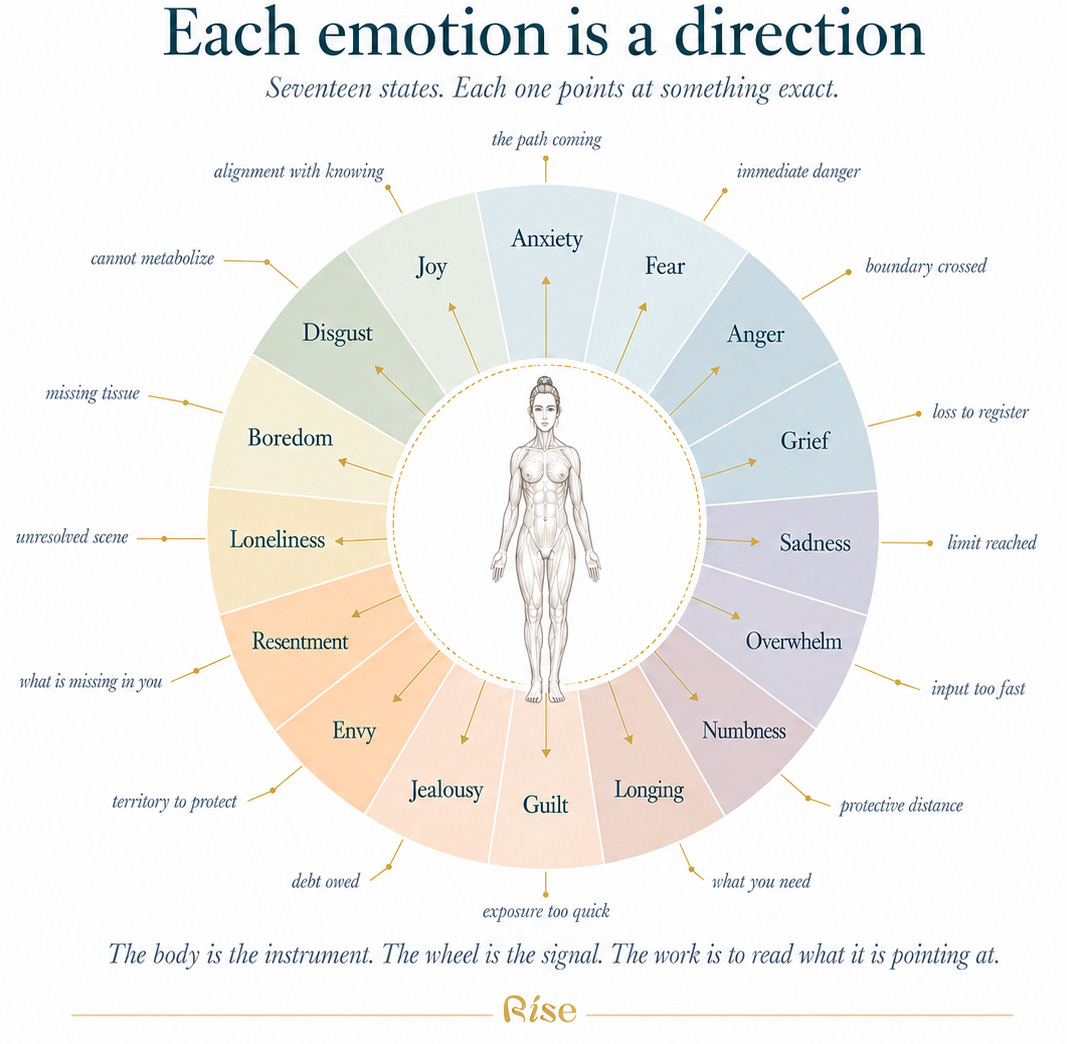
Here are the seventeen states this Signal names, each one read as a direction the body is pointing at.
Anxiety is the body recognizing it is about to walk into something it knows is not safe. Fear is the body’s recognition of immediate threat, a sharper, more localized version of anxiety. Anger is the sorrow underneath that has nowhere else to go. Grief is the body’s weight registering what was lost. Sadness is the body recognizing that it has had enough. Overwhelm is the body capsized by what is being poured into it faster than it can metabolize. Numbness is the body taken away from itself, dissociated as a survival response to too much. Longing is the body stretching toward what it knows it needs. Shame is the body’s impulse to cover what has been exposed too quickly. Guilt is the body’s accounting of what it took without permission.
Jealousy is the body’s fierce protection of what it knows is its territory. Envy is the body looking at what is not yet visible inside itself, projected onto someone else who is showing it. Resentment is the body feeling the same thing repeatedly because it has not yet been integrated. Loneliness is the body recognizing that it is in a room without the relational tissue it requires. Boredom is the body stuffed full of something that does not nourish it. Disgust is the body’s chemistry recognizing something it cannot metabolize. Joy is the inward gladness that arises when the body is in alignment with itself.
Each one is a direction. Each one carries instruction the conscious mind does not have access to. The work is to read what the body is reading.
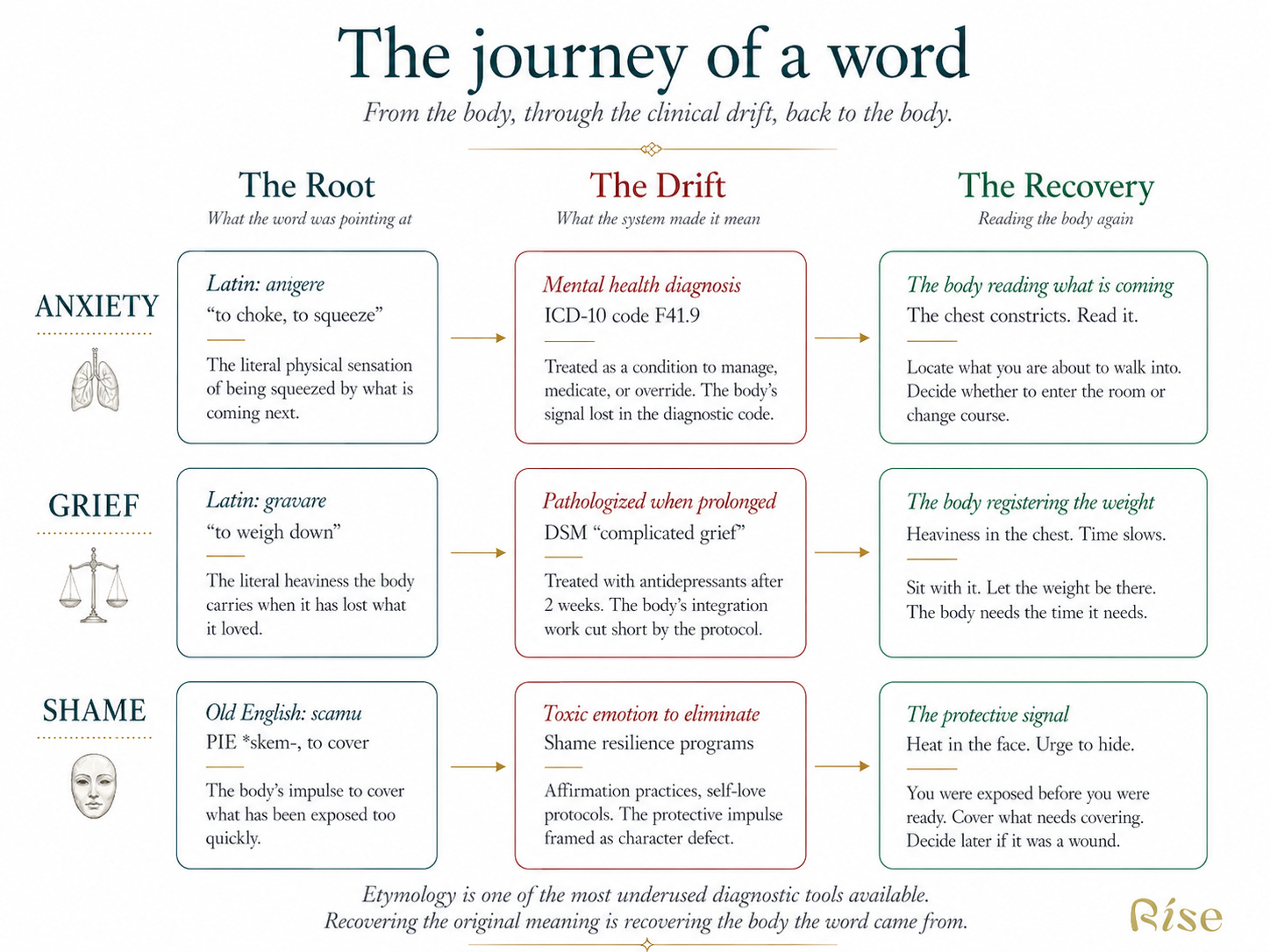
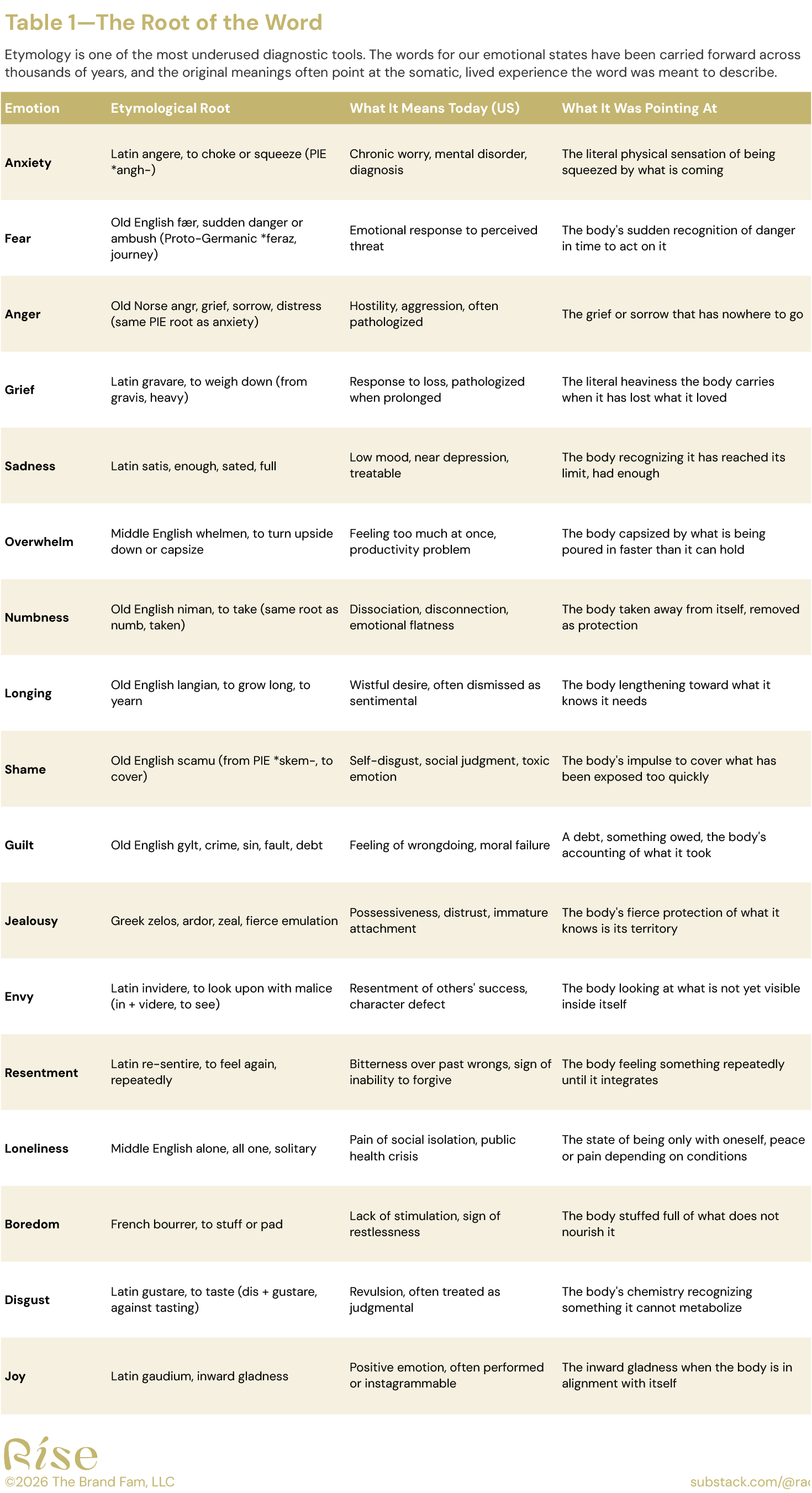
Etymology is one of the most underused diagnostic tools available to us. The words for our emotional states have been carried forward across thousands of years, and the original meanings often point at the somatic, lived experience the word was meant to describe. The modern usage has frequently drifted from the original to the abstract, the diagnostic, or the pathologized. Recovering the etymology is recovering the body the word came from.
Read this table left to right. Column one names the emotion. Column two names the etymological root. Column three names what the word means in the United States today. Column four names what the word was actually pointing at originally.
For every emotion the body sends as instruction, the modern architecture has built a corresponding interpretation that pathologizes the signal, and an intervention designed to silence it. The framing comes from the medical, pharmaceutical, and wellness industries collectively, all of whom benefit from the body’s emotions being treated as conditions to be treated rather than directions to be followed.
Read this table left to right. Column one names the emotion. Column two names what society and the systems tell us it means. Column three names what we do as a result, the intervention the architecture has built. Column four names what this costs us.
