Inversions: The Food Chain Is Built to Make You Weak & Forget
Signal 58. The food you reach for is a direct reading of your pain. The chain engineers the reaching, sugar to soften the dissatisfaction it helped create, and the water carries the forgetting.

I think most of us were raised with Kraft Mac & Cheeze and the Miracle of Wonder Bread, trading apples for Twinkies and feeling empowered by being fully out of survival mode into the season of choice. And our choice has been continuously wrapped in dopamine since the 80s.
It’s hard for us to imagine a time when we went without as a US economy. Even those who are impoverished have access to packaged foods through our US WIC and Food Stamp programs, which cover many necessities as well as the more important choices for our caloric system.
Calories are just energy. We believe that we need them in the form of ingestion or ‘food’ to ensure we can exist in our most full form here on planet earth. Actually, we tie intake to vitality, and what we consume actually enables us to feel well, by media standards.
You have probably been taught that food is fuel, that the calorie is the unit of measure, that the macronutrient balance is what matters, that the diet you choose is a matter of personal preference, and that if you would just count more carefully, exercise more consistently, and resist the cravings more disciplinedly, your body would be the body it was supposed to be. The supermarket aisles, the diet books, the food labels, the GLP-1 prescriptions now being written at scale, and the wellness influencers selling their meal plans are all running on the same premise, which is that the body is a machine, the food is fuel for the machine, and the right inputs produce the right outputs.
The data underneath the food story is overwhelming, and it has been overwhelming for decades. Roughly 73% of US adults are now overweight or obese, up from roughly 46% in 1980. Type 2 diabetes has tripled in prevalence in the same window. Children are presenting with metabolic syndromes that the pediatric literature did not have categories for 32 years ago. The fastest-growing pharmaceutical category in 2024 was the GLP-1 receptor agonists, drugs originally developed for diabetes and now being prescribed at scale for obesity, with global sales projected to exceed $100 bn dollars annually by 2030. The ultra-processed food category, defined by the NOVA classification system as foods produced through industrial formulations that no home kitchen could replicate, now accounts for roughly sixty percent of caloric intake in the average American diet.
Soil microbial diversity has been hollowed out by industrial agriculture across the same decades that the human gut microbiome has been hollowed out in parallel. Roughly 73% of Americans on public water systems receive fluoridated water. Per-capita sugar consumption in the United States has remained near one hundred and fifty pounds per person per year for decades, despite the medical evidence on what that level of consumption does to the body.
And this is only the current view.
A food system that produces the conditions a pharmaceutical industry then treats, a water supply that contains a substance with documented effects on the gland the body uses to know itself, and a sugar industry that has been subsidized into the bloodstream of every American since the post-war agricultural consolidation, while every sector involved generates record profits and the body of the country gets sicker and less able to read what is happening to it every year. It is reading the symptom as the disease. It has been doing that since the post-war agricultural and food science consolidation in the 1950s and 1960s, when the modern food architecture was assembled out of the surplus capacity left over from wartime production. The bodies are now telling us what that has cost, and the cost has been showing up not just in our chemistry but in our consciousness, in our relationships, in our ability to be content with what we are, in our ability to read our own intuitive field.
What’s Happening Beneath the Surface
Now turn the reading.
Food is medicine, food is a mirror, food is the chemistry through which the soul speaks to the body about what it is hungry for, and the modern industrial food system has built itself on the premise that hunger can be answered with engineered products that produce a dopamine response without ever delivering the nourishment the body was actually asking for. The hunger is the diagnostic and the plate is the readout. What is on the fork is what is on the heart, and what is on the heart is what the soul has been waiting to be heard about, and the industry has built itself on keeping us from hearing it.
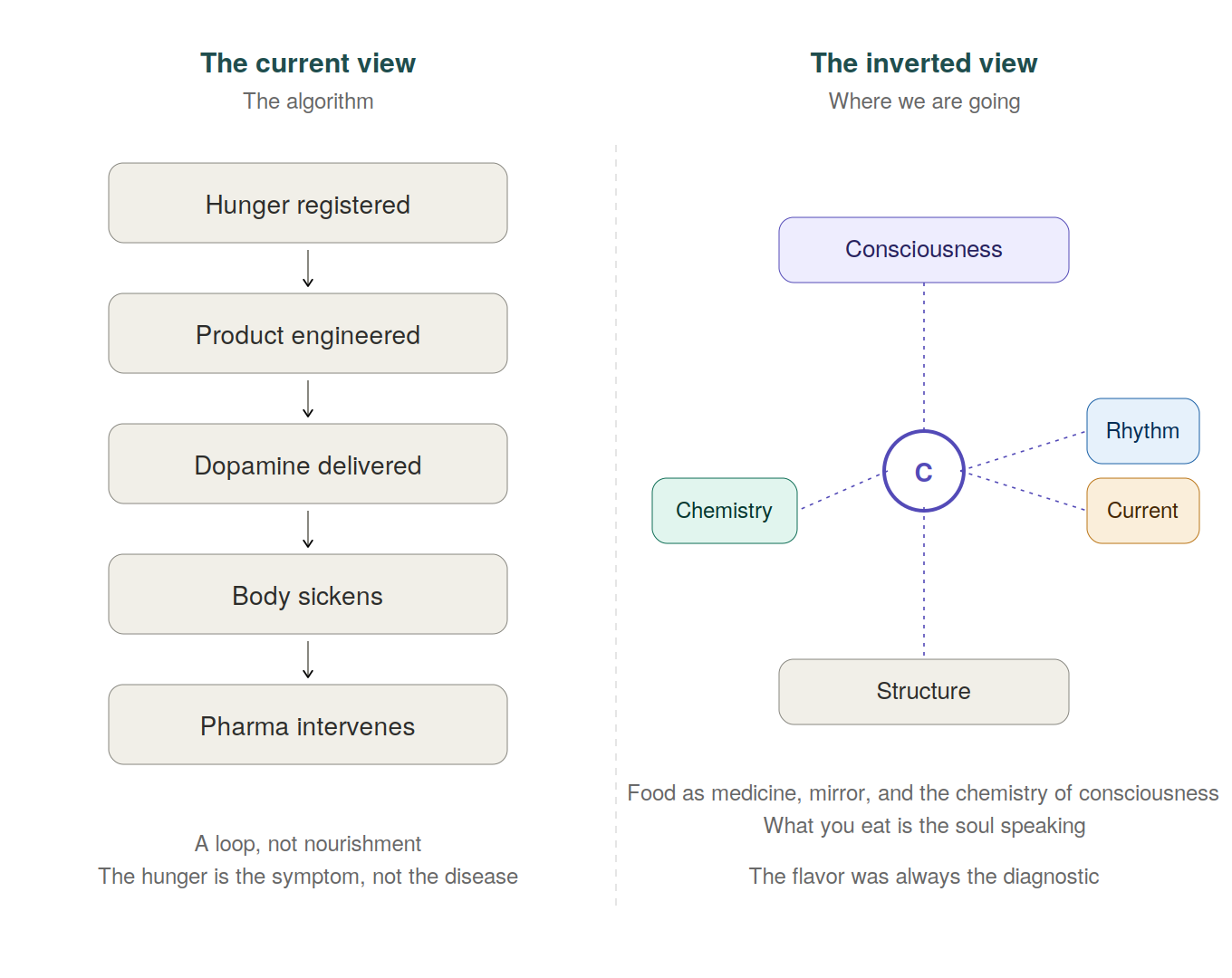
Here is the inversion: The current view treats food as a market category to be optimized for flavor, shelf life, profit margin, and consumer preference, with the body of the eater treated as a passive consumer of the optimization. The inverted view treats food and water as the chemistry through which the body is in continuous conversation with the land, the soul, and the lineage, and the diagnosis is not in the calorie count or the dental health framing but in what the body is actually being fed and what the body is being kept from feeling.
The system is doing what it was built to do. The food chain makes the body weak. The water chain makes the body forget. The weakness and the forgetting are the products. The chain extracts from both.
Fluoride as the Cleanest Example
I want to spend a moment on fluoride specifically, because fluoride is the cleanest single example of the structural diagnostic this Signal is running, and because the conversation about fluoride has been treated as conspiracy theory long enough that the substantive science underneath the conversation has been pushed out of public view. Stay with me through the technical paragraphs that follow, because what comes out the other side is the recognition that the architecture of public health and the architecture of consciousness suppression are running together at the water supply layer in a way the population has never been given the framework to read.
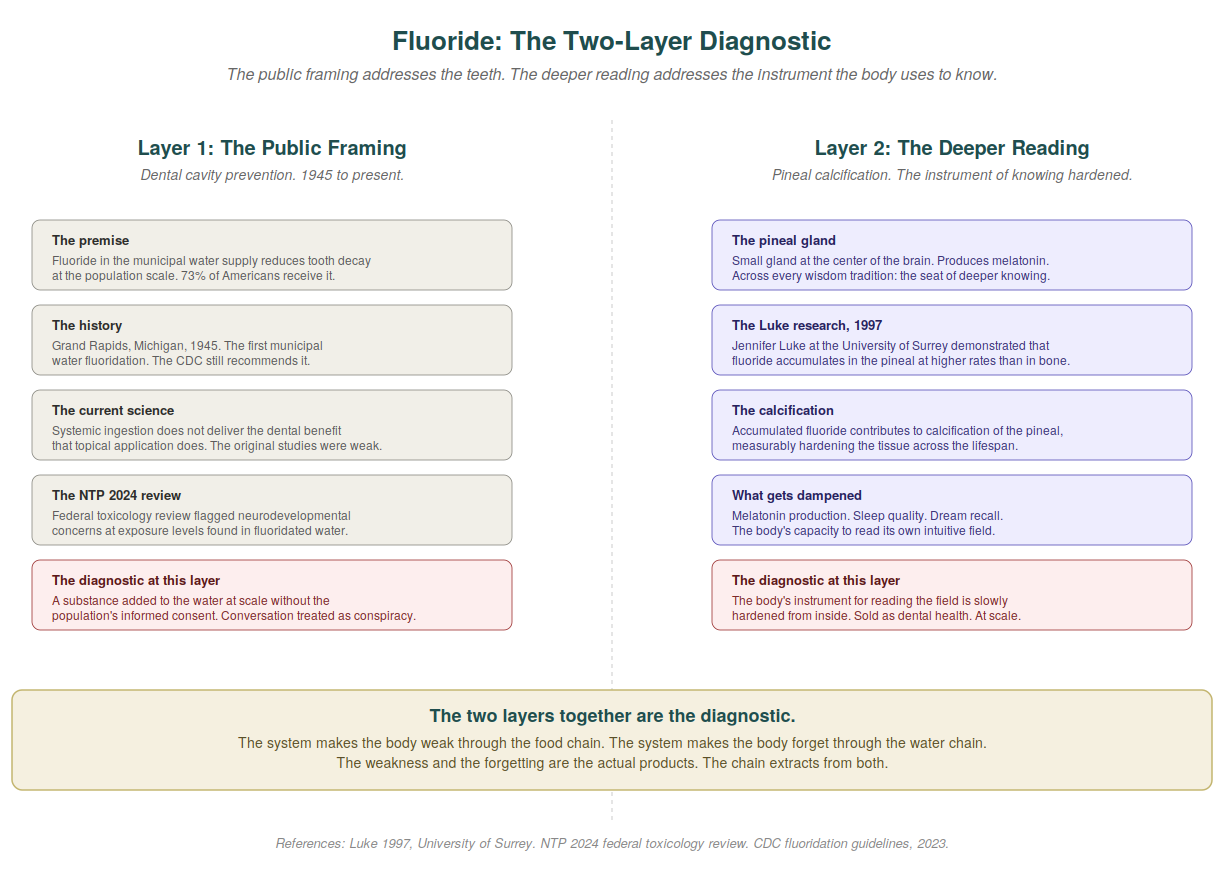
Layer one is the straightforward diagnostic and it is enough on its own to qualify fluoride as one of the largest unaddressed public health questions of the modern era. Municipal water fluoridation began in Grand Rapids, Michigan in 1945, on the premise that fluoride added to the water supply at scale would reduce dental cavities in the population. The CDC continues to recommend the practice. Approximately seventy-three percent of Americans on public water systems now receive fluoridated water.
The contemporary scientific understanding is that the dental benefit comes primarily from topical application of fluoride to the tooth surface, not from systemic ingestion through the water, which means the water fluoridation program has been delivering a dose of a bioactive substance to the bodies of an entire population for eighty years without delivering the dental benefit that justified the program in the first place. The original studies underneath the public health architecture were significantly weaker than the public health architecture has acknowledged, and the National Toxicology Program’s 2024 federal review flagged neurodevelopmental concerns at exposure levels found in fluoridated water.
The diagnostic at this layer alone is that a substance was added to the water supply at the population scale, without informed consent, on the basis of evidence that was weak then and that the current science has substantially questioned, and the conversation about whether the practice should continue has been treated as conspiracy theory whenever it surfaces in public discourse.
Layer two is the deeper reading and it is the reading that the wisdom traditions have been pointing at for as long as the wisdom traditions have existed. The pineal gland is a small gland at the center of the brain that produces melatonin, regulates the body’s circadian rhythm, and across nearly every contemplative tradition has been associated with the body’s deeper intuitive faculty. Hindu and Buddhist traditions name it as the seat of the third eye. The Egyptian eye of Horus mapped onto the gland’s anatomical position. Descartes called it the seat of the soul. The contemplative Christian, Sufi, and Kabbalistic traditions all reference an equivalent inner faculty seated approximately where the pineal sits. The contemporary scientific understanding of the pineal is partial and is still actively developing, but the basic mechanism is clear. The pineal produces melatonin in response to darkness and regulates dream cycles, sleep architecture, and the body’s deeper rhythmic intelligence.
Jennifer Luke’s 1997 doctoral research at the University of Surrey demonstrated that fluoride accumulates in the pineal gland at higher rates than it accumulates in bone, that the accumulation contributes to calcification of the pineal tissue across the lifespan, and that the calcification appears in significant percentages of the adult population in fluoridated regions. Subsequent research has continued to develop the picture but the foundational finding has held. The body’s intuitive instrument is being slowly hardened from the inside by a substance added to the water supply at scale, sold to the population as dental health, and the population has been given no framework for understanding what is being dampened.
What gets dampened, when the pineal calcifies, is the body’s capacity to produce melatonin at the levels the body evolved to produce, the dream recall the deeper integrative work depends on, the sleep architecture the immune system requires to do its actual work, and the felt sense of the intuitive field that the contemplative traditions have been pointing at for thousands of years. The body becomes weaker at the level of the immune and endocrine systems, and the body becomes more forgetful at the level of the intuitive and integrative faculties, simultaneously, through the same substance, delivered through the same water supply, sold to the same population as a public health benefit.
This is what I mean by the title of this Signal. We are driving illness through the system to make you weak and to forget. The illness is the body of evidence the food chain has been producing for eighty years. The forgetting is what the water chain has been producing for the same eighty years. The two run together. They are not separate phenomena. They are one architecture, optimized at every layer for the extraction of value from a population that has been kept just sated enough to keep buying, just sick enough to keep treating, and just dampened enough to stop asking what is happening.
What’s Happening Overall
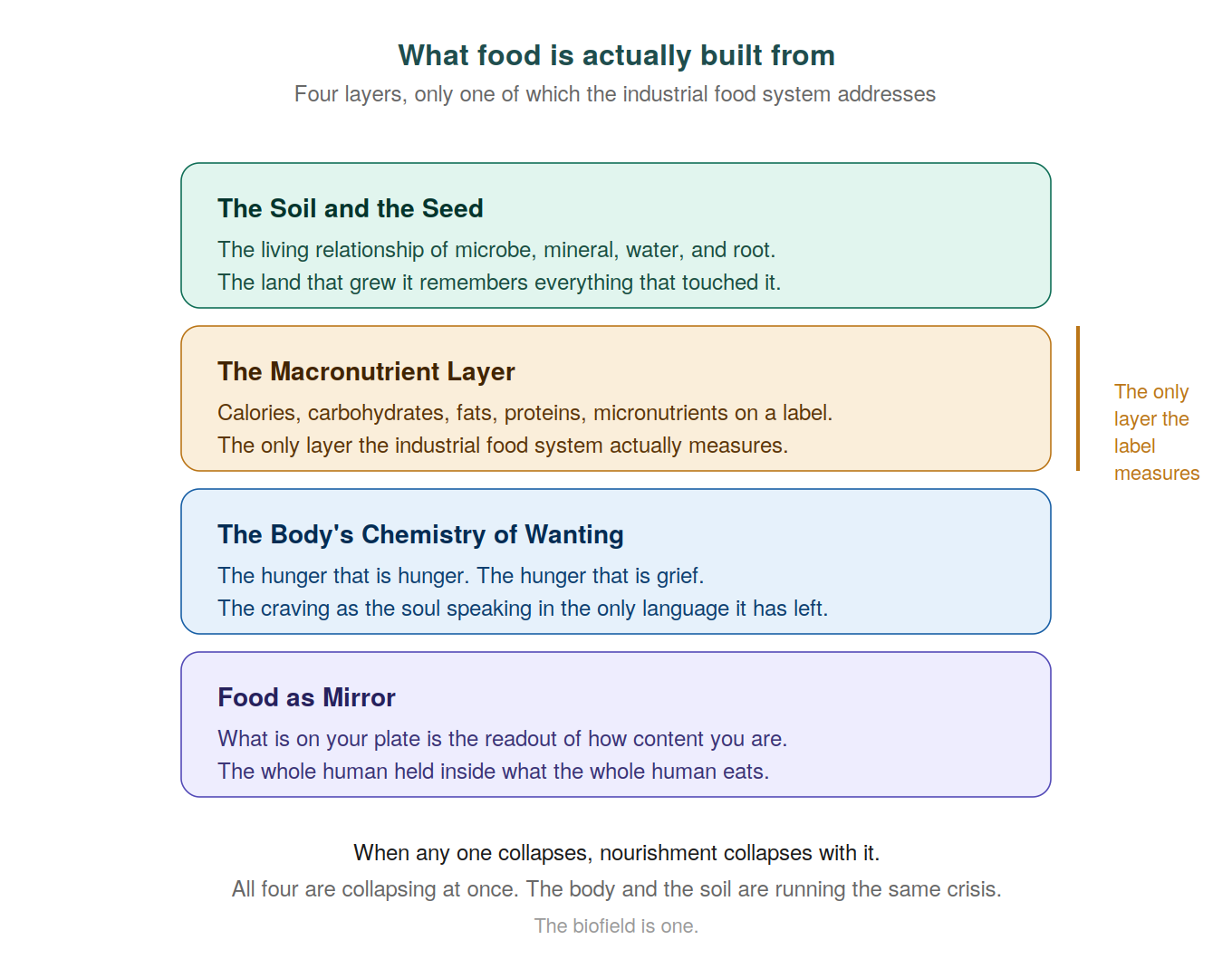
Food is built from four things, and the industrial food system only measures one.
The soil and the seed, the living relationship of microbe, mineral, water, and root, which is the foundation everything else rests on, and which the modern industrial agriculture has been systematically destroying for the better part of a century through monoculture, synthetic fertilizer, glyphosate, and the engineering of crops for shipping rather than for the bodies that eat them.
The macronutrient layer, the calories and carbohydrates and fats and proteins and micronutrients that appear on the label, which is the only layer the food industry actually measures, and which is the layer the nutrition science of the last fifty years has reduced the entire conversation to as though the label were the meal.
The body’s chemistry of wanting, the hunger that is hunger and the hunger that is grief and the hunger that is loneliness and the hunger that is the soul speaking in the only language it has left, all of which the industry has been engineering products to address while never asking the deeper question of what the body was actually hungry for.
Food as mirror, the deepest layer, which is the recognition that what is on your plate at any given moment is the readout of how content you are with your soul’s work and how connected you are to the body you are living inside of, and the deeper you get into the work the more the food on the plate begins to change without anyone needing to enforce the change.
When any one of these collapses, nourishment collapses with it. All four are collapsing at once.
This is the through-line of the entire Inversions Series. The biofield is one. The polarization between the eater and the food, between the body and the soil, between the soul and the chemistry, between the dental cavity and the pineal gland, is the illusion the algorithm runs on. The unity is what the algorithm refuses to see. What you are reading in Food and Water, you are also reading in Climate (the soil that grew us no longer remembered as alive), in Insurance (the chronic conditions the industry both produced and now insures against), in Religion and Spirituality (the intuitive instrument the contemplative traditions have been protecting that the water chain has been calcifying), and in Health (the body whose first language is the food it eats). Same crisis. Different organ.

Sugar as the Companion Diagnostic
Alongside fluoride, the other substance worth naming explicitly is sugar, and I want to give it more space than the original draft of this Signal had room for. A standalone subset piece on sugar specifically is coming, because the diagnostic deserves the full attention of its own essay, but the Food Signal would be incomplete without the structural recognition.
The American sugar industry has been one of the most successful industrial lobbying operations in the post-war era. In 1967, the Sugar Research Foundation, which has since become the Sugar Association, paid Harvard nutrition researchers to publish a literature review in the New England Journal of Medicine that minimized the role of sugar in cardiovascular disease and directed the public health attention toward dietary fat instead. The 2016 Kearns et al. paper in JAMA Internal Medicine documented the payments and the editorial direction. The redirection shaped fifty years of nutrition policy, fifty years of dietary guidelines, and fifty years of medical training, and the bodies of the American population have been carrying the consequences of that redirection in their metabolic chemistry ever since. The 2015 Coca-Cola funding scandal demonstrated that the same architecture was still operating, with Coca-Cola funding the Global Energy Balance Network to redirect the obesity conversation toward exercise rather than caloric intake from sugary beverages.
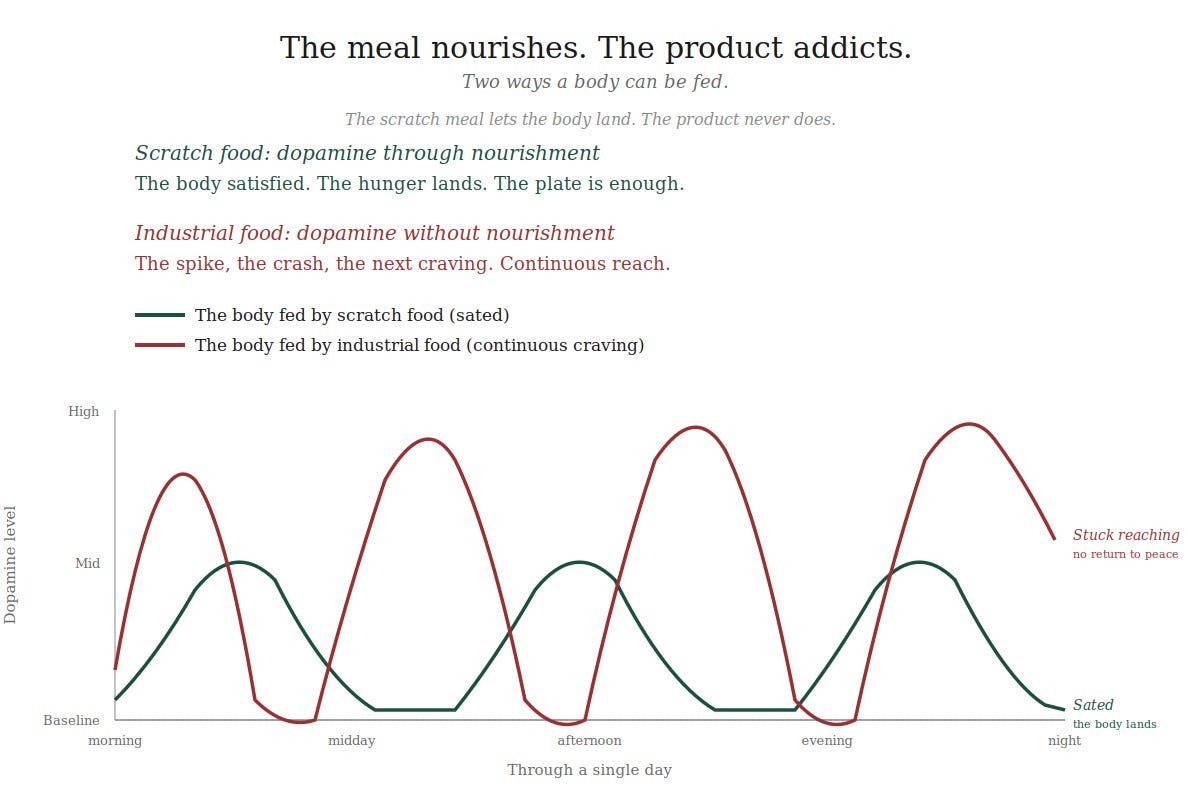
The dopamine response sugar produces is structurally similar to the dopamine response cocaine produces, with the brain imaging studies from the early 2000s showing activation patterns in the same reward pathways. The body that has been continuously primed with the sugar response stops being able to find pleasure in anything that does not deliver the spike, which is the same architecture the Nervous System Signal named as the dysregulation the body cannot return from. The processed food industry has engineered sugar, salt, and fat into precisely calibrated combinations that target what the food scientist Howard Moskowitz called the bliss point, the specific ratio at which the body’s reward system fires hardest. The bliss point is not a metaphor. The bliss point is a measurable physiological response that the industry has been engineering products around for decades.
My children have been eating more sugar than usual lately between Iza’s thirteenth birthday and the cakes and the candy that accompany that ritual, and what I have been doing with the kids inside that consumption is naming what sugar is doing in the body so that they can feel it for themselves. Sugar is a drug. Sugar changes the biochemistry of the body and the brain in measurable ways. We are running this conversation with the kids as part of their chemistry curriculum and as part of their understanding of why the food on the plate matters, not as a moral question but as a chemistry question and a consciousness question. The standalone piece on sugar will go deeper into the architecture of the industry and the architecture of the body’s response, and into the specific practices we have built for navigating sugar inside a household that does not pretend the sugar does not exist.
My Experience & What I Witnessed
I have spent 25 years in this industry in different roles, and the through-line of those twenty years is that the system chose me before I chose it, and that choosing was the slow education of a single body learning what is actually possible to know about food from the inside.
My first on-the-books job was at McDonald’s in Carlisle, Pennsylvania, at the age of fourteen. My softball and field hockey teammates' mother had just opened the franchise, and I needed money, and I was willing to do everything that the job required. I was the drive-thru girl, and I did everything asked of me. I worked with pride inside a fast food job, and the sign out front in 1990 still read Millions and Millions Served rather than the Billion it would later become. I could not eat anything on the menu except the fries, and the grease from the fryer broke my forehead out in something that looked like chicken pox within my first month (pimples from the grease), and what I now understand about that experience is that the job chose me so that I could see the system from the inside before I had developed the conceptual frameworks to defend against what I was seeing. The body learned first. The mind caught up later.
After college, I spent twenty years in the food industry in various forms across various roles, and the arc of those twenty years was the arc of a single body trying to understand how to fix what the early McDonald’s experience had already told me was broken. I started the urban agriculture work at TILT in Baltimore and we ran the urban forest project across the city and built Ecofest annually for years, and the work was always about the relationship between the land and the food and the body. I went to City Harvest in New York, which is the food rescue organization that distributes surplus food from restaurants and retailers to people who would otherwise go hungry, and I learned at City Harvest that the supply chain in this country produces enough food to feed every person on the continent twice over, and the hunger problem is therefore not a production problem but a distribution problem, which is a chemistry problem of money flow rather than a chemistry problem of food.
I worked at Chobani during the years it was scaling, and I want to say something positive about Chobani specifically because the company is one of the few I have worked with that built something real from a vision rather than from an optimization. Hamdi Ulukaya was a wandering Turkish child himself before he became the founder, and he took a fifty thousand dollar bank loan and built an empire that thinks generationally rather than quarterly, and the manufacturing operations are partially employee-owned at the factory level, and the company has continued to support refugee employment at scale through every economic cycle since its founding. The yogurt category was extraordinarily difficult to win in because the product is highly perishable and the margins are thin, and Chobani won through innovation and through a kind of creativity that the rest of the industry has not been able to replicate.
Then I went to a company in Guatemala in 2014 that was extracting natural products for the perfume industry, and while I was there I watched a community organize to drive Monsanto out of their fields and reinstate the heritage maize their grandmothers had been growing for centuries. The energy in those gatherings was unlike anything I have ever felt at a US food or climate event, and the energy was not against the corporation but for the seed and the soil and the lineage and the food the grandmothers had cooked. The corporation left because the field had reorganized around something brighter, and the lesson I took from that year was that the food fight is winnable when the people remember what they are fighting for.
And then I landed at the Krispy Kreme franchisor in Las Vegas, which was the most concentrated education in human pain I have ever received in twenty years of food industry work. The Krispy Kreme business model was fascinating because the average customer bought two dozen doughnuts every four months, which meant the product was not a daily food but an occasional ritual, a sugary glazed treat that punctuated the rhythm of a life rather than fueling it. In Vegas I experienced humanity in all its forms, but mostly the most overtly in pain, the underbelly of the human race walking through the casinos and the strip and the all-night convenience stores, and we were serving them doughnuts. I learned a tremendous amount in that period about how pain manifests in the body and what dopamine does inside food, and Vegas is itself one continuous dopamine pill coming for you every second of the day that you are there, a gross display of hell and an extraordinarily educational one. I watched the bars all along the strip get replaced with food-centered places that had alcohol on the side, and what I understood watching that shift was that the food was the real comfort, the real medicine, the real chemistry these souls were trying to feed themselves with because the actual nourishment they needed was no longer culturally available.
Somewhere inside that period I had a conversation with Maria Velissariou, who was the Chief Science Officer at Mars and had spent her PhD and her career inside the corporate science of one of the largest food companies on Earth. I asked her, knowing what she knew about what Mars produced, whether she felt bad about it, and her answer was extraordinarily clean. She said, no, we had to expand to our farthest reach first to figure out what to do next. She said it without apology and without defensiveness, and what I understood from her was the framing I had been looking for for the entirety of my spiritual journey through the food industry. We had to push the algorithm to its outer edge so that we could see, from the outer edge, what the algorithm had been missing. The work she was doing was not the work of fixing the industry. The work she was doing was the work of pushing the industry to the point where it could see what it had become.
My Kitchen Now
I cook three meals a day for my children from scratch, and we eat very few things that come out of a package, and we drink the well water from our property in Simsbury that tastes so good we do not want to leave home because we cannot stand the flavor of bottled or chlorinated water when we travel. The well water is also unfluoridated, which means my children have not been receiving the cumulative pineal exposure most American children receive through municipal water, and the sleep architecture and dream recall they have access to is different from what they would have access to in a fluoridated water environment. This is not a small thing. This is structural. We have a CSA at Holcomb Farm, which is a community-supported agriculture operation here in Simsbury that has been running for decades and which produces vegetables and fruit that the body recognizes as food in a way that the supermarket produce never quite manages. The chemistry of what arrives in the box each week is the chemistry of a piece of land that has been farmed with care, and what arrives in the bodies of my children after a season of eating from that farm is the chemistry of children who can stand in their minds and ask questions that the children eating the other thing cannot ask.
This is the deeper diagnostic of the food work. When you do not feel well, and when your intuitive instrument is dampened, you are less inclined to stand in your power and ask the questions the moment requires. The food and the water you ingest are the chemistry of your willingness to be awake, and the industry and the public health architecture both know this, and the products and the protocols they deliver are designed to keep you just sated enough to keep buying and just dysregulated enough to keep needing and just dampened enough to stop asking. The work in my kitchen is not the work of being a perfect mother. The work in my kitchen is the work of building the chemistry that allows my children to become themselves, and the work at the tap is the work of refusing the substance that would dampen what they came in with.
The Whole Human as Extraction Surface
Here is the diagnosis I want you to sit with.
We as an industry are hurting the whole human in the middle to extract from us. From our soul to our bank account, the chain that runs through the body of the modern eater is designed to extract at every layer of what we are, and the layers it extracts at are the layers we have been taught to think of as separate when they are in fact one continuous body.
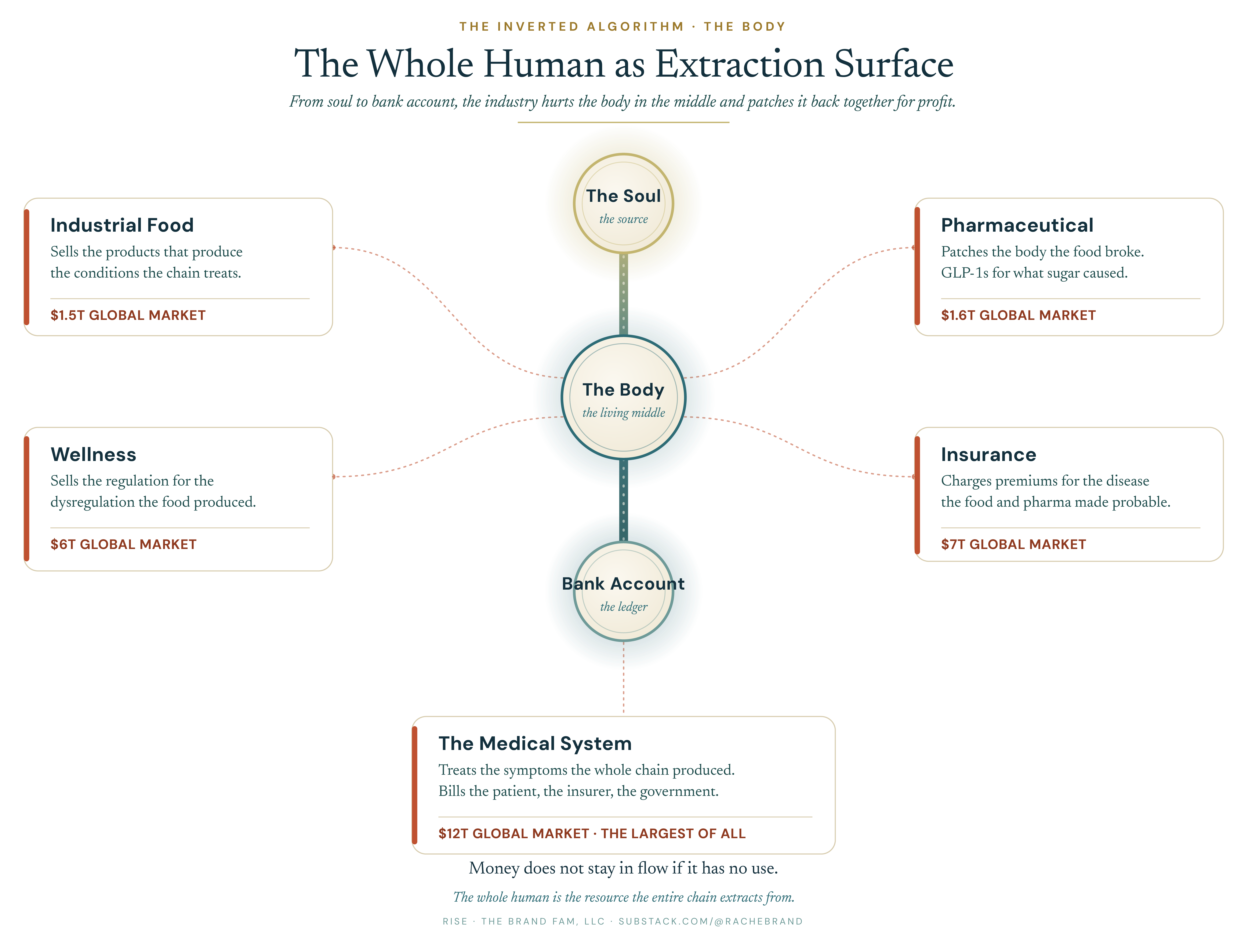
Industrial food sells you the products that produce the metabolic conditions, then the pharmaceutical industry develops the GLP-1 receptor agonists to treat the conditions the food industry produced, and the medical system bills the insurance industry for the treatment, and the insurance industry charges the household premiums that have been rising faster than wages for twenty years, and the wellness industry sells the regulation for the dysregulation the food industry produced in the first place. The whole chain is one body. The body the chain is feeding on is yours.
Money does not stay in flow if it has no use. The use the modern economy has built itself on is the use of extraction, which means the architecture of money flow now requires that the body of the human remain in continuous distress at the chemical level so that the chain has something to extract from. Heal the body and the chain has nothing to feed on. The industry knows this. The industry will not say it. The industry is running exactly as it was designed to run.

What the Experts are Saying
The lineages converge.
Michael Pollan named the diagnosis in The Omnivore’s Dilemma and In Defense of Food twenty years ago when he wrote that eaters in the industrial food system have been systematically separated from any direct relationship with the food they eat, and the separation has been engineered as a feature of the system rather than as an unfortunate side effect. Wendell Berry has been writing for fifty years that eating is an agricultural act and that to eat industrially is to participate in the destruction of the land that grew you.
Vandana Shiva’s work on seed sovereignty and the corporate capture of agricultural genetics through Monsanto and the consolidation of the global seed industry has been the diagnostic underpinning of the kind of community resistance I witnessed in Guatemala in 2014. Casey Means and her brother Calley Means have been writing recently about metabolic health as the underlying frame the entire medical system has been missing. Robert Lustig’s clinical work on sugar and fructose metabolism, particularly Fat Chance and Metabolical, has been showing the biochemistry of what the industry has been doing to children’s bodies. Max Lugavere on brain health and food. Mark Hyman on functional medicine.
On fluoride specifically, the foundational research is Jennifer Luke’s 1997 doctoral thesis at the University of Surrey, with subsequent peer-reviewed publication in 2001 in Caries Research. Phyllis Mullenix’s 1995 work at Forsyth Dental Center demonstrated neurodevelopmental effects of fluoride exposure in animal models and led directly to the public attempt to discredit her work and remove her from her position, which is itself diagnostic of how the architecture protects itself. The Fluoride Action Network has been the most consistent advocacy organization working on this thread for decades, with Paul Connett’s The Case Against Fluoride remaining the foundational synthesis. The National Toxicology Program’s 2024 federal review represents the first major federal acknowledgment that the neurodevelopmental concerns have a scientific basis the public health architecture has been working around.
On sugar, the foundational scholarly work documenting the industry’s role in shaping the public health conversation is Kearns, Schmidt, and Glantz’s 2016 paper in JAMA Internal Medicine, which documented the 1967 Sugar Research Foundation payments to Harvard researchers. Marion Nestle’s Soda Politics and Unsavory Truth document the broader architecture. Gary Taubes’s Good Calories, Bad Calories and The Case Against Sugar provide the deeper scientific argument.
“The food you consume is a direct reflection of the pain you are in. The water you drink is a direct reflection of what you are being allowed to remember.” — Rache Brand
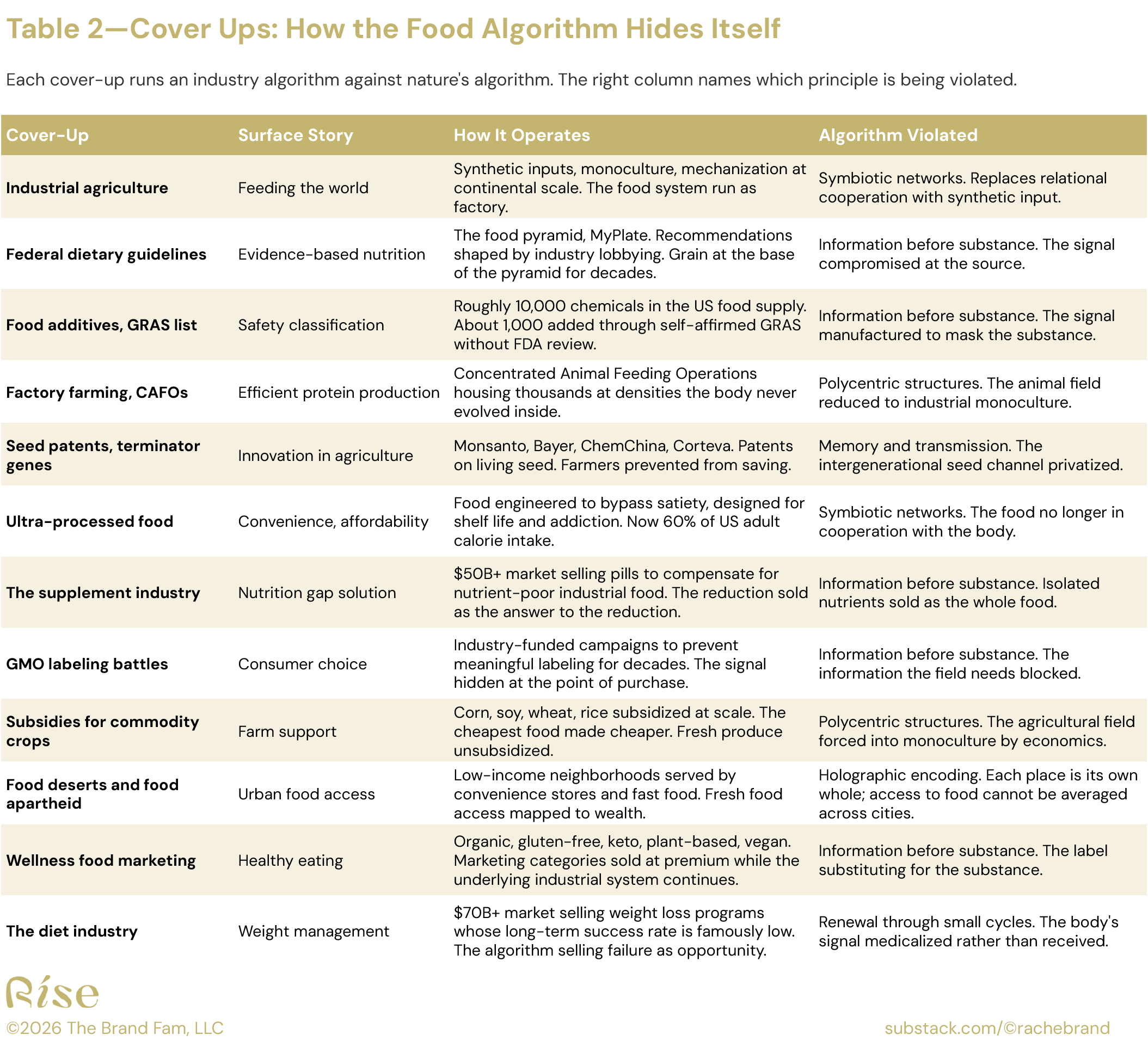
Food Events, Cover-Ups, and Chronic Conditions
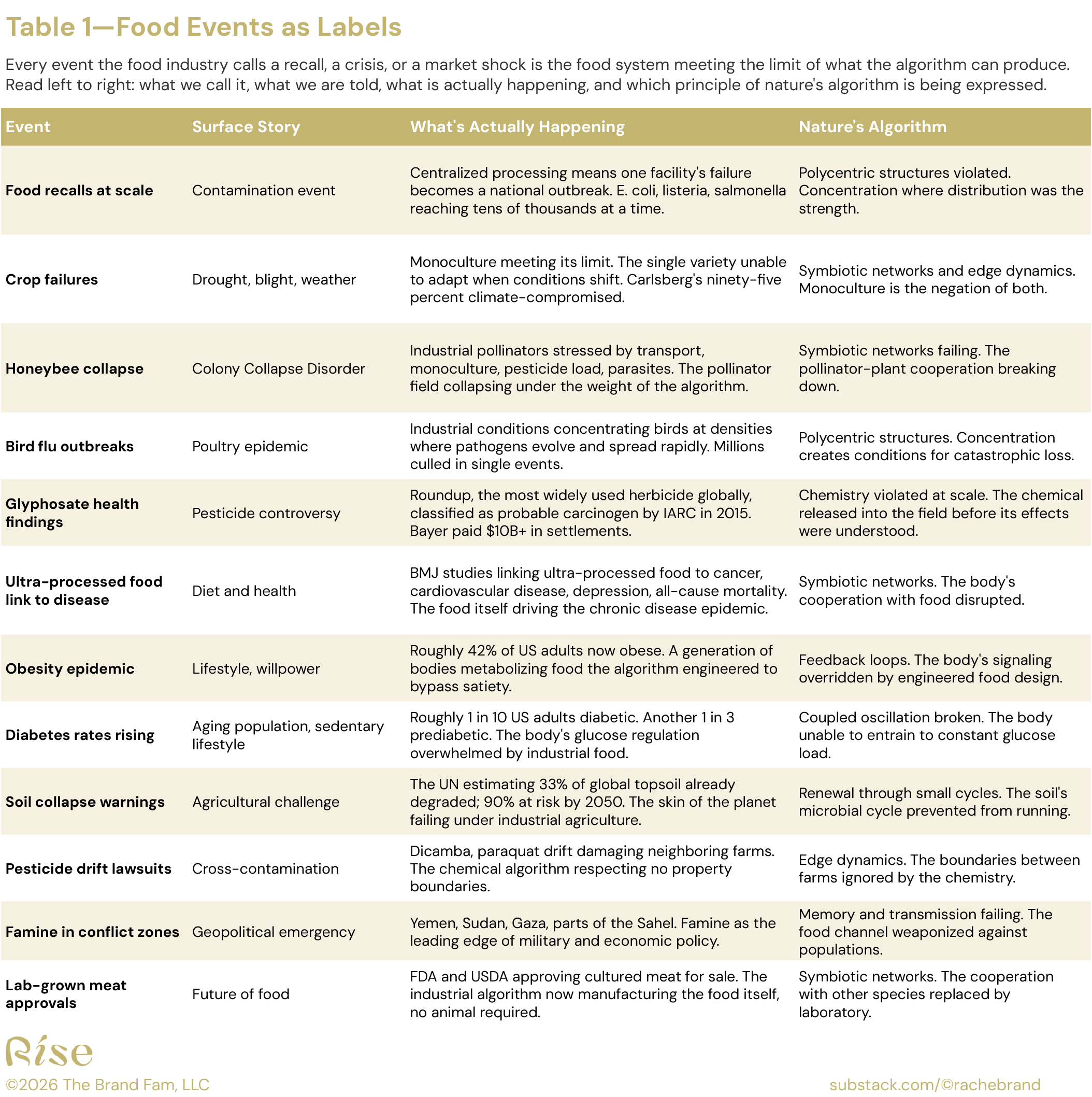
Every event the food and medical press call an epidemic is the body of the population completing a renewal it was forbidden to run at smaller scale. The signal is the event. The event is the medicine we need to look at.
Every event the food and medical press call an epidemic is the body of the population completing a renewal it was forbidden to run at smaller scale. The signal is the event. The event is the medicine we need to look at.