Inversions: Media Sells Your Attention Back to You Exactly How They Want it
Signal 060. You were taught the press is the watchdog. It was built to inform the public, selling attention back to the very minds it harvests to keep in control.


What We Have Been Taught
If you asked me two years ago to use Tik Tok, you would have gotten a “How do I do that?” look. Having tweens, however, makes you pretty savvy. They help you jump through the hoops of all these things you have to do to get oriented correctly from security things to codes. And then voila, you have a Substack account, and you have been on the platform for a full year.
My life has changed in this year, completely. I have a subscription to the New York Times, but I only read Substack. If it is not on here, I don’t know about it. And interestingly, most of the time I really only stay in my feed and in my community. I sometimes go to the main board, and I am astonished by what is going on in the world.
But it has been necessary to do this effort of inward thinking while I was in the mix of this deep personal introspection and after processing through this post I know why. There is no way I could have been quiet enough in my own mind with all this noise around us. Boy is it crazy.
You have probably been taught that the media is the watchdog of the public interest, the institution that holds power accountable and the architecture through which democratic societies remain informed enough to govern themselves. I call absolute bullshit. The legacy newspapers, broadcast networks, cable channels, and news websites have collectively built an identity around this self-description for the better part of a century, and that identity has shaped how readers and viewers interpret what they encounter on the page or the screen. Actually you are not a good citizen and you are mildly ‘dumb’ if you don’t know what’s going on in the world.
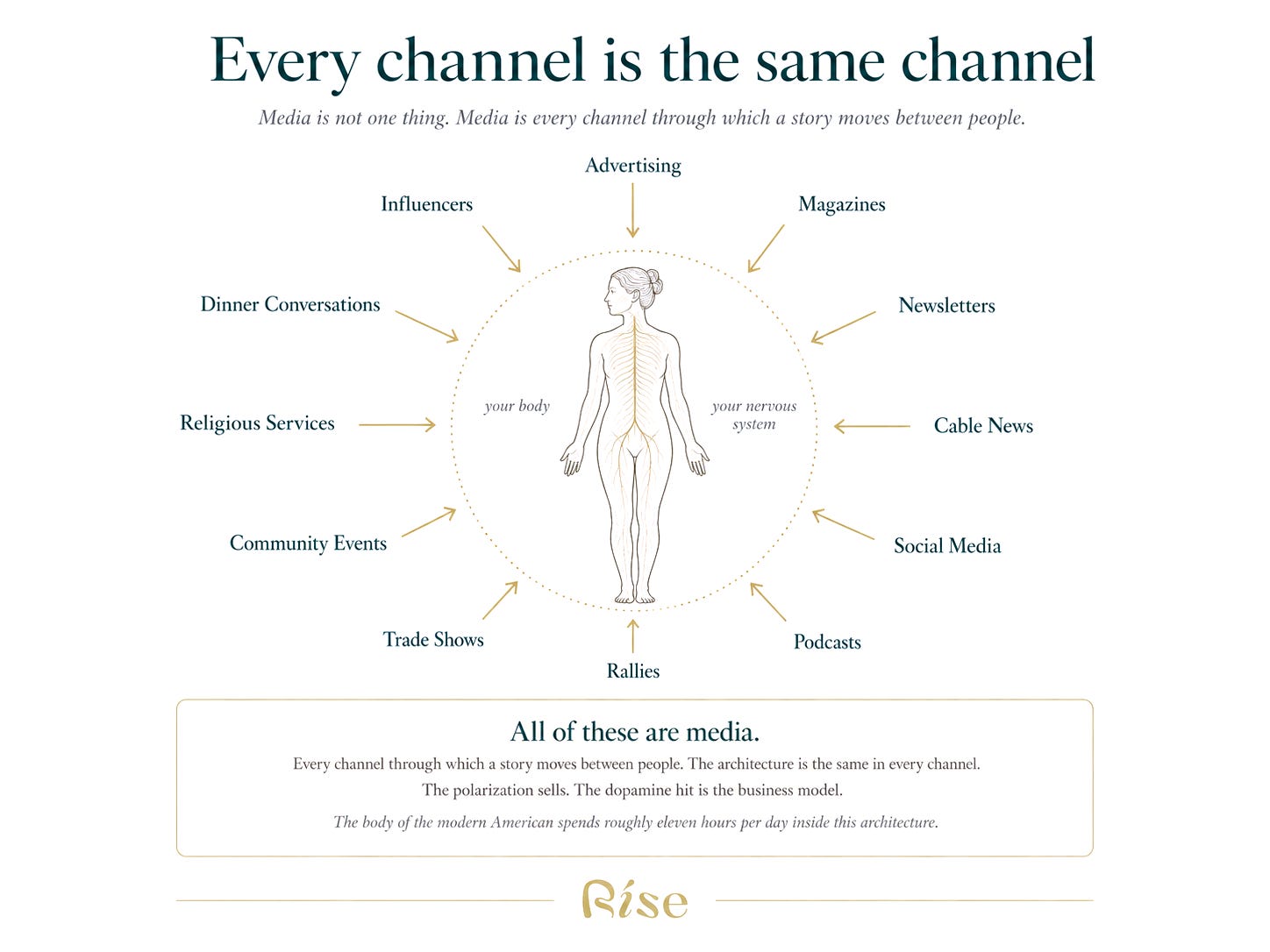
And I want to widen the lens before we go any further, because the conversation about media tends to focus on the newspaper and the cable network and the platform, and that framing is too narrow. Media is not one thing. Media is every channel through which a story moves between people. The 30-second commercial during the football game is media. The glossy magazine in the doctor’s waiting room is a form of media. The Substack arriving in your inbox at 6am is media. The political rally in the stadium is media. The church service on Sunday morning is media. The volunteer day at the community garden where conversation among the volunteers turns to the news of the day is media. The trade show in Las Vegas where the keynote speech sets the industry conversation for the next six months is media. The neighborhood meeting at the library is media. The podcast in your headphones is media. The billboard, the campaign sign, the Twitter thread, the YouTube video, the documentary, the movie, the book, the sermon, the speech, the dinner table conversation about something everyone saw. All of it is media. Every channel through which a story moves between people.
I think you get it. But just making sure… here is a visual.
What’s Happening
The data underneath the media story is straightforward. Trust in mass media in the United States is at roughly 31% as of 2024, down from 68% in 1972. The number of working journalists has declined by roughly half since 2008 as newspapers have closed across the country. Local news has been hollowed out, with more than two thousand counties now classified as news deserts.
The remaining major outlets have consolidated into a handful of ownership groups. Cable news viewership is collapsing in absolute terms even as the audience that remains has become more polarized in its consumption. Social platforms now deliver more news to more Americans than any single traditional outlet. The attention economy has grown to roughly $2 trillion globally if you sum platform advertising, content production, and the indirect monetization of user attention. The body of the country reads less, watches less of any single thing, and trusts less of what it reads or watches than at any point in modern memory.
And this is only the current view.
A media architecture optimized for engagement rather than for truth, delivering the same story in slightly different voices to different audiences, calibrated to keep each audience inside its own algorithmic bubble long enough to be sold to advertisers, and producing a population that knows more facts than any in history while understanding less of what those facts mean. It is reading the symptom as the disease. The misinformation everyone names as the crisis is not the disease. The misinformation is the symptom. The disease is the architecture that produces misinformation at scale because misinformation is what the engagement metric selects for.
What’s Happening Beneath the Surface
Now turn to the reading.
The media is not a watchdog. The media is the nervous system of the collective body, the architecture through which the body of the country reads itself, and that nervous system has been progressively colonized by a measurement framework that selects for the chemistry of activation rather than integration. Outrage performs better than nuance. Fear performs better than steadiness. Certainty performs better than inquiry. The architecture has been selected for these qualities over two decades, and the body of the country has been adapting to receive what it delivers.
Here is the inversion.
The current view treats media as a content industry whose product is information delivered to consumers. The inverted view treats media as the relational tissue between people who share a place, a moment, or a question, and recognizes that the tissue itself is the medicine, not the content it carries.
The mycelium network in a forest does not deliver news. The mycelium network is the relational tissue through which the forest knows itself. The forest’s information moves through the network because the network is healthy. When the network is poisoned, the forest stops knowing itself. The body of the country has been operating inside a poisoned network for two decades and the disorientation we now experience as collective reality is the diagnosis.

The Dopamine Hit Is The Business Model for Media
I want to name the mechanism plainly, because once you see it you cannot unsee it.
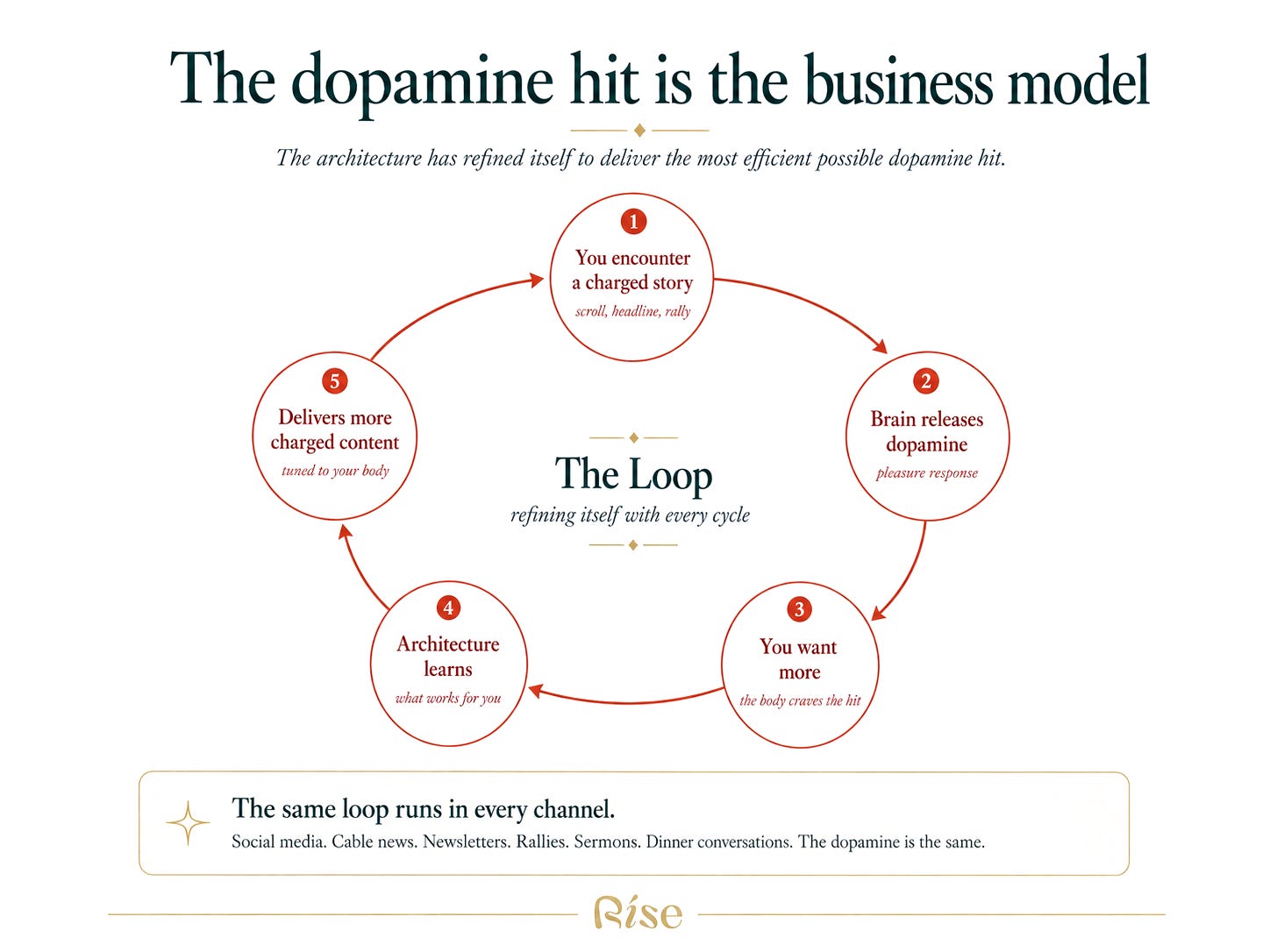
Every time you encounter a piece of media that confirms what you already believe, your brain releases a small amount of dopamine. The dopamine is pleasurable. The pleasure makes you want more. The architecture that delivers the dopamine learns what produces the strongest response in you and delivers more of that. Over time, the architecture has refined itself to deliver the most efficient possible dopamine hit, which turns out to be the story that is most charged, most polarizing, most likely to confirm your existing position while also enraging you about the opposing one. The same mechanism runs whether you are scrolling social media, watching cable news, reading your favorite newsletter, attending a political rally, watching a sermon, or sitting around a dinner table where everyone agrees with you about how wrong the other side is.
The dopamine response is the same. The platform is incidental. Social media did not invent this mechanism. Social media optimized this mechanism more efficiently than anything before it. The underlying architecture has been with us since the first newspaper learned that scandal sold more copies than reporting. The advertising industry built itself on this recognition starting in the 1920s. The political consultants built their entire profession on this recognition starting in the 1960s. The cable news networks built their ratings on this recognition starting in the 1980s. The platforms built their algorithms on this recognition starting in the 2000s. The Substack writers and the podcast hosts are now building their audiences on the same recognition, and most of us are aware of it and still doing it because the dopamine architecture pays better than the reflection architecture.
This is not a critique of any individual creator or outlet. This is a recognition that the architecture itself is built on the body’s biochemistry, and the architecture has selected for the channels and the personalities that produce the strongest response. The reflective writer who refuses to polarize gets ten thousand readers. The polarizing writer who chooses outrage gets ten million. The architecture is doing what the architecture was built to do.
Throwing You Off The Scent
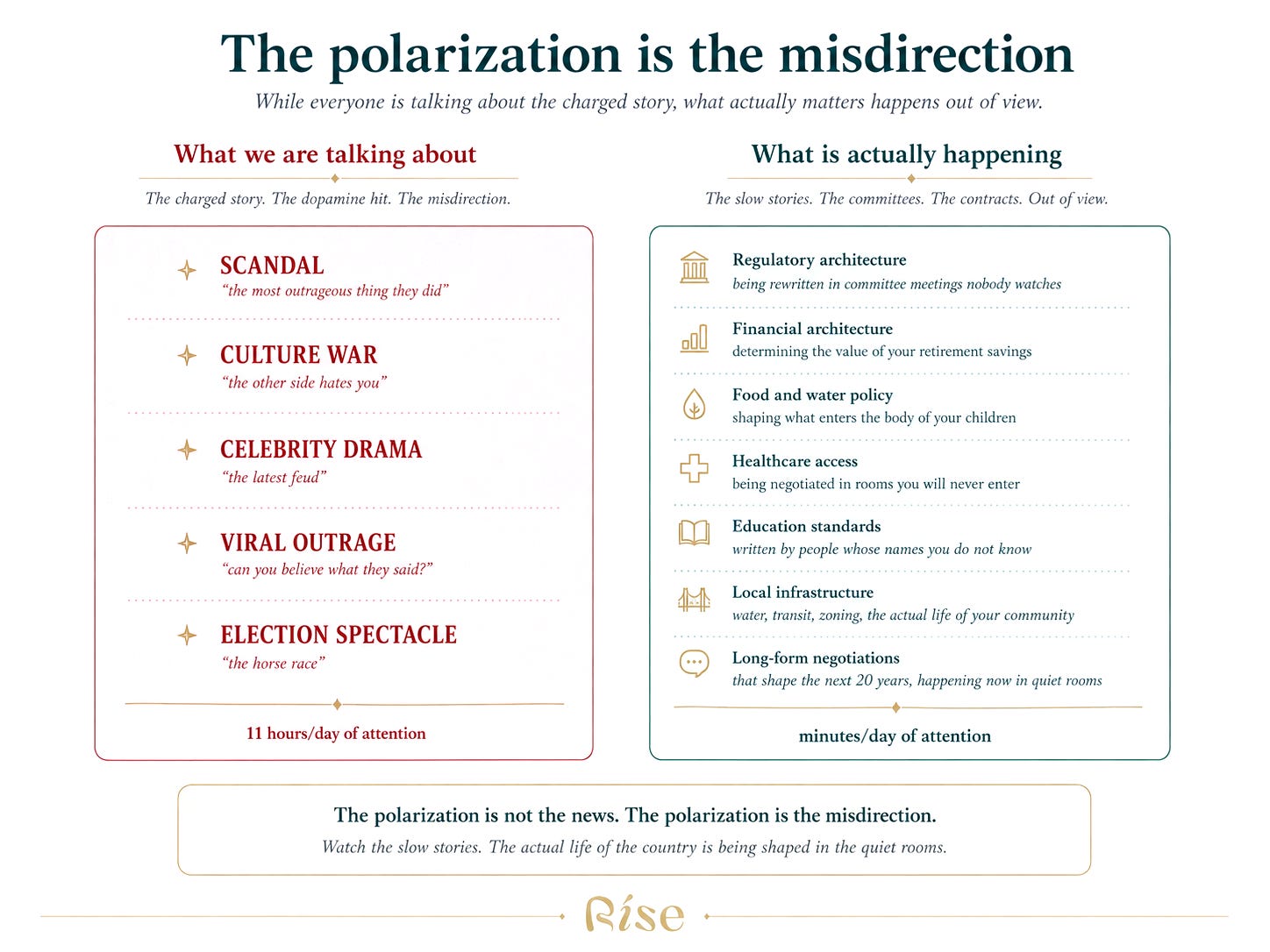
Here is the part I want to say plainly. While we are all talking about the most polarizing story available, what actually matters is happening out of view.
While we are watching the news about the latest political scandal, the regulatory architecture that governs the food we eat is being rewritten in committee meetings nobody is watching. While we are scrolling the latest social media outrage, the financial architecture that determines the value of our retirement savings is being reorganized through processes that almost no one has the patience to track. While we are at the political rally chanting about the people who are not in the room, the laws that govern our access to medical care, the standards that govern the safety of our drinking water, the policies that govern the education our children receive, are all being written by people whose names we do not know in rooms we will never enter. The polarization is the misdirection. The polarization is what keeps the attention occupied while the actual architecture continues.
This is not a conspiracy. No actors are sitting in rooms deciding to misdirect the population. The architecture itself produces the outcome. The polarization sells. The polarization gets the clicks, fills the seats, energizes the donors, drives the engagement, generates the revenue. The institutional work of regulation, governance, infrastructure, and care does not produce a dopamine response and therefore does not get the attention. The economy of attention has selected for the charged story and against the slow story. The slow story is where the actual life of the country is being shaped. The charged story is where we are spending our hours.
The Competing Messages Are Now Impossible To Track
Twenty years ago, when most Americans got their news from three television networks and a handful of major newspapers, the conversation was constrained but at least it was the same conversation. You and your neighbor might disagree about what to do about an issue, but you were generally working from the same set of facts. The architecture had a small number of central nodes, and the central nodes generally agreed on what was happening even when they disagreed on what it meant.
That architecture is gone. The contemporary media environment is so fragmented that two people standing next to each other can be receiving completely different information about the same event, filtered through completely different algorithmic systems, framed by completely different personalities, with completely different versions of which facts are actually facts. The advertising your neighbor sees is targeted to a different profile than the advertising you see. The news your colleague reads is curated by a different algorithm than the news you read. The community gathering your sister attends tells a different story than the community gathering you attend. The rallies your cousin watches are different rallies than the ones you watch. The dinner conversations at every other family’s dinner table are taking place inside completely different media environments than the conversations at yours.
This is structural. This is not an accident of the moment. The architecture has fragmented so completely that the shared information environment that was the precondition for any kind of collective conversation is gone, and the competing messages are now nearly impossible to track even for the people whose full-time job is tracking them.
My Experience
I spent an hour yesterday on LinkedIn after writing here on Substack, and I had to keep digging to find anything that felt alive. I wanted to find something good. I found one post that was interesting. The volume of high-quality videos and promotional efforts was exhausting. The content was saying the same thing in slightly different voices, which is buy my thing, it is better than the next thing. I felt sad knowing how much energy and time these beautiful souls had poured into producing content that was structurally indistinguishable from the content next to it. The architecture is asking everyone to perform the same content optimization, and the people doing the performing are paying the cost in time, energy, and a slowly hollowed sense of what they were actually trying to say.
The New York Times retraction this year about Trump was an instructive moment for me. The retraction itself was the news, but the news inside the news was the architecture that produced the original error in the first place: an editorial culture that has been optimizing for a particular reader long enough that the optimization now shapes the reporting before it reaches the page. The retraction is not the failure. The retraction is the moment when the architecture was forced to acknowledge what it had been doing all along. The same is true of every major media correction we have watched unfold over the last decade. The corrections are not the malfunction. The corrections are the moment when the body of the country forces the architecture to read what it has been refusing to read.
My children use YouTube, TikTok, and other platforms as research tools, not as entertainment, as the adult conversation usually frames them. They are training their own algorithms on what they search for, what they spend time on, and what they get back, which is closer to a curated library of inquiry than to a feed of distraction. The platforms are neutral in their capacity. Use determines what the platform delivers. The adults who are panicking about screen time are usually those whose own use of the same platforms is largely passive, and they are projecting that passivity onto the children, whose use is active. This is worth saying carefully because it is the opposite of the standard parental concern, and it is what I have actually observed inside our house.
I read approximately one hundred books a year. I have done this for two years now. The reading is the practice through which I have built the framework I am writing inside of, and the framework is the practice through which I read the news. Without the framework, the news arrives as a series of disconnected events that produce activation without integration. With the framework, the news arrives as data points the body knows how to read against the larger pattern. The reading and the writing and the framework all work together. None of them is sufficient on its own.
What The Experts Are Saying
The lineages converge.
Marshall McLuhan wrote sixty years ago that the medium is the message, which is to say the architecture of communication shapes what can be communicated through it more than the content of any individual communication does. His work has only become more relevant as the platforms have multiplied. Neil Postman extended this in Amusing Ourselves to Death, arguing that television’s entertainment frame would eventually colonize politics, journalism, education, and religion. Colonization has now occurred across every platform-mediated domain.
Nicholas Carr’s The Shallows documented how the internet affects the human capacity for sustained attention. Tristan Harris and the Center for Humane Technology have been naming the specific algorithmic mechanisms by which the platforms select for activation. Jonathan Haidt’s recent work on adolescent mental health and smartphone adoption named the consequences at the developmental layer. Anna Lembke’s Dopamine Nation walked the clinical neuroscience of the reward pathway the entire architecture has been running on. Tim Wu’s The Attention Merchants documented the century-long history of the attention economy from the first penny press through the modern platforms. Shoshana Zuboff’s The Age of Surveillance Capitalism named the architecture that turns the user’s attention into the primary commodity of the modern economy. The literature is extensive and the diagnosis converges. The architecture is not neutral. The architecture is selecting for the chemistry the country has been running on.
“Misinformation is not the disease it is the symptom in this case. The disease is the architecture that makes it impossible to get outside of it. The polarization is the misdirection that keeps us occupied while what actually matters happens out of view.” — Rache Brand
Media Events and Cover-Ups
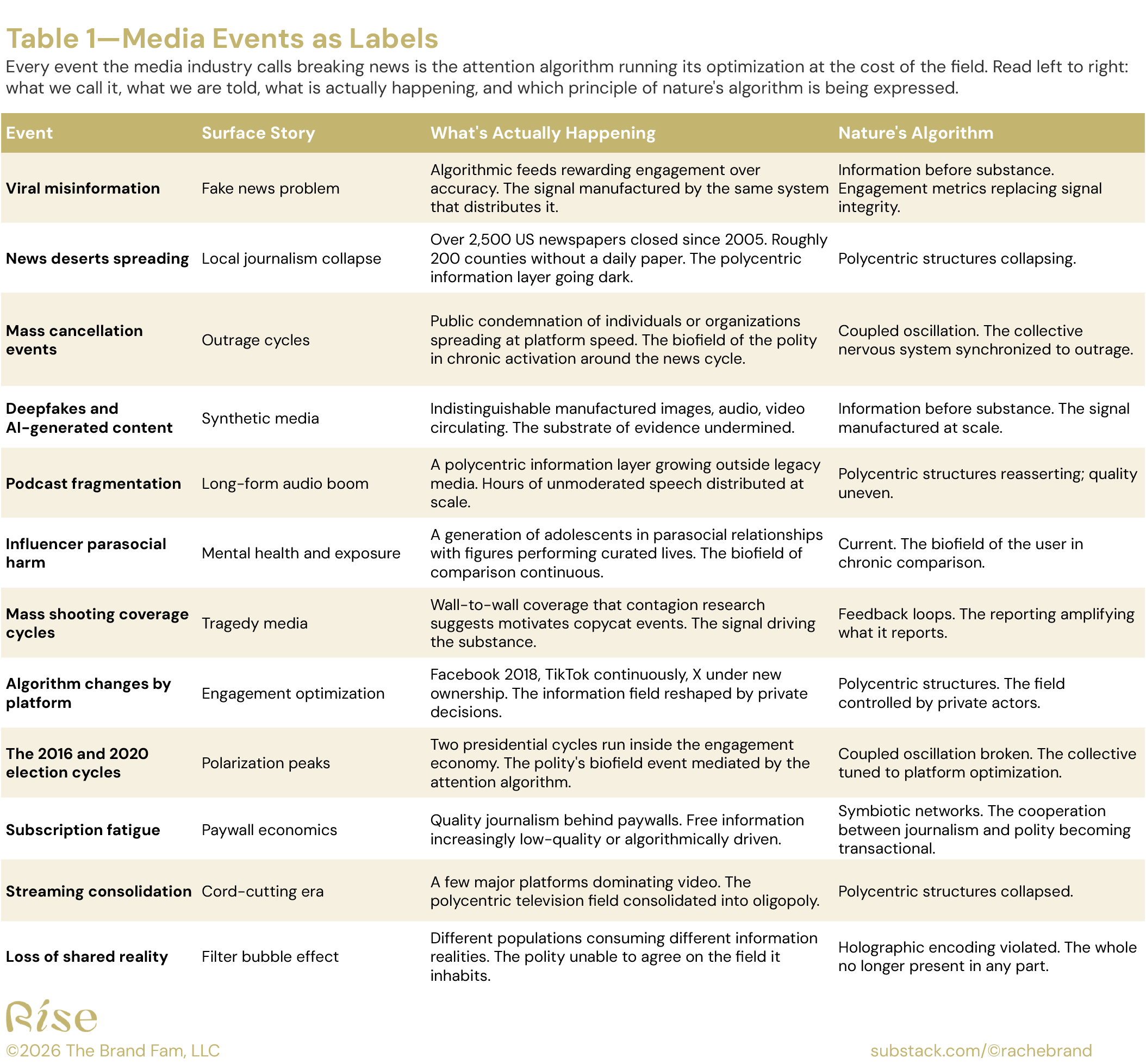
Read this table left to right. Column one names the event. Column two is the surface story. Column three names what is actually happening. Column four names the principle of nature’s algorithm the body is expressing.