

Inversions: What You Bring to the Machine—Technology is Only as Good as Your Trust in Yourself
Signal 061. Technology is everything from the pencil to the chair. The fear of AI is consciousness displaced onto the tool, the human abdicating the seat.


I love AI. I can’t imagine my life without it, and I know that we are living in this era specifically to go through this experience and this moment to come back to each other through this incredible system.
But you have probably been taught that we are living through a technological revolution that is either going to save us or destroy us, depending on which set of experts you read this week.
The conversation has been organized into two camps: the accelerationists argue that the artificial intelligence build-out represents the most important technical inflection in human history and that we should embrace it, while the doomers argue that the same build-out poses an existential risk that we should slow or stop. Both camps have been getting most of the funding and most of the airtime. The actual conversation about what the technology is for, who is using it, what consciousness underlies its use, and whether the build-out is even the most consequential thing happening on the technology layer right now has largely been absent from public discussion.
The data underneath the technology story is overwhelming and accelerating. OpenAI, Anthropic, Google, Meta, and a handful of other companies are now spending tens of billions of dollars annually on AI infrastructure. The major language models have moved from a research curiosity in 2020 to a consumer product in 2022 to a professional infrastructure in 2024 to a deeply embedded utility across nearly every knowledge-work domain in 2026. Roughly fifty percent of American workers in white-collar roles now report using AI tools in their daily work. The smartphone, which is now nearly two decades into its mass deployment, sits in the hands of roughly $5 billion people globally and shapes a significant portion of the waking attention of every person who carries one. The wearable market is expanding into continuous biometric monitoring. The home is being instrumented with sensors that report on the activity of the people inside it to a small number of companies. The car is becoming a sensor platform that happens to also transport people.
And this is only the current view.
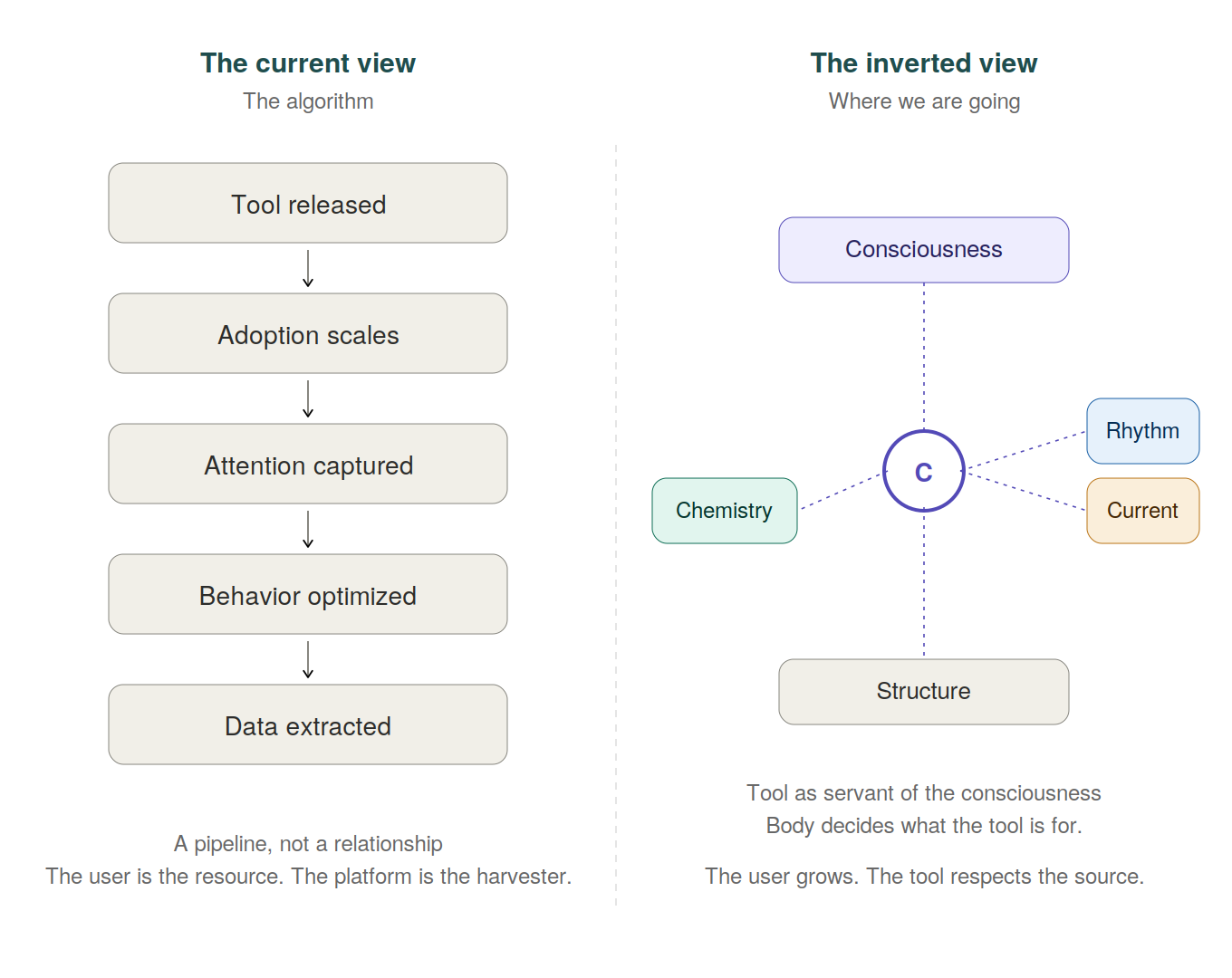
A technology architecture is treated as either a savior or a threat without ever asking the deeper question of what the technology is being used for and who is using it. The conversation about AI has been organized around the technology itself rather than the consciousness deploying it, and has therefore missed the central diagnostic. The fear of AI is largely the displacement of the fear we should have been holding about the consciousness running the older tools. The smartphone was the previous decade’s AI. The television was the decade before that. The mass-produced newspaper was the century before that. Each technology arrived and reorganized human consciousness, and the consciousness that emerged on the other side of that reorganization was the one that built the next technology. The cycle is not new. The current version of it is louder.
What’s Happening Beneath the Surface
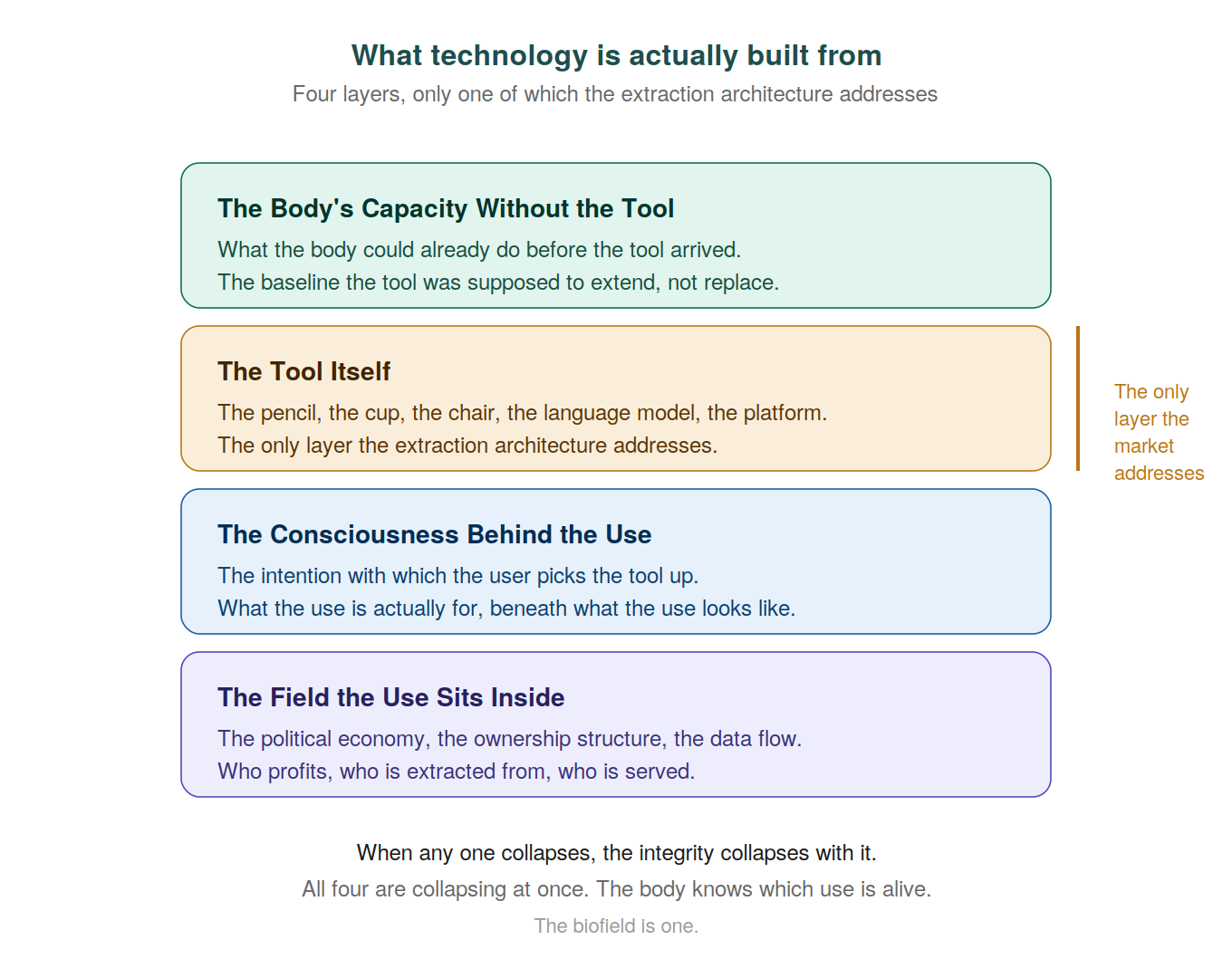
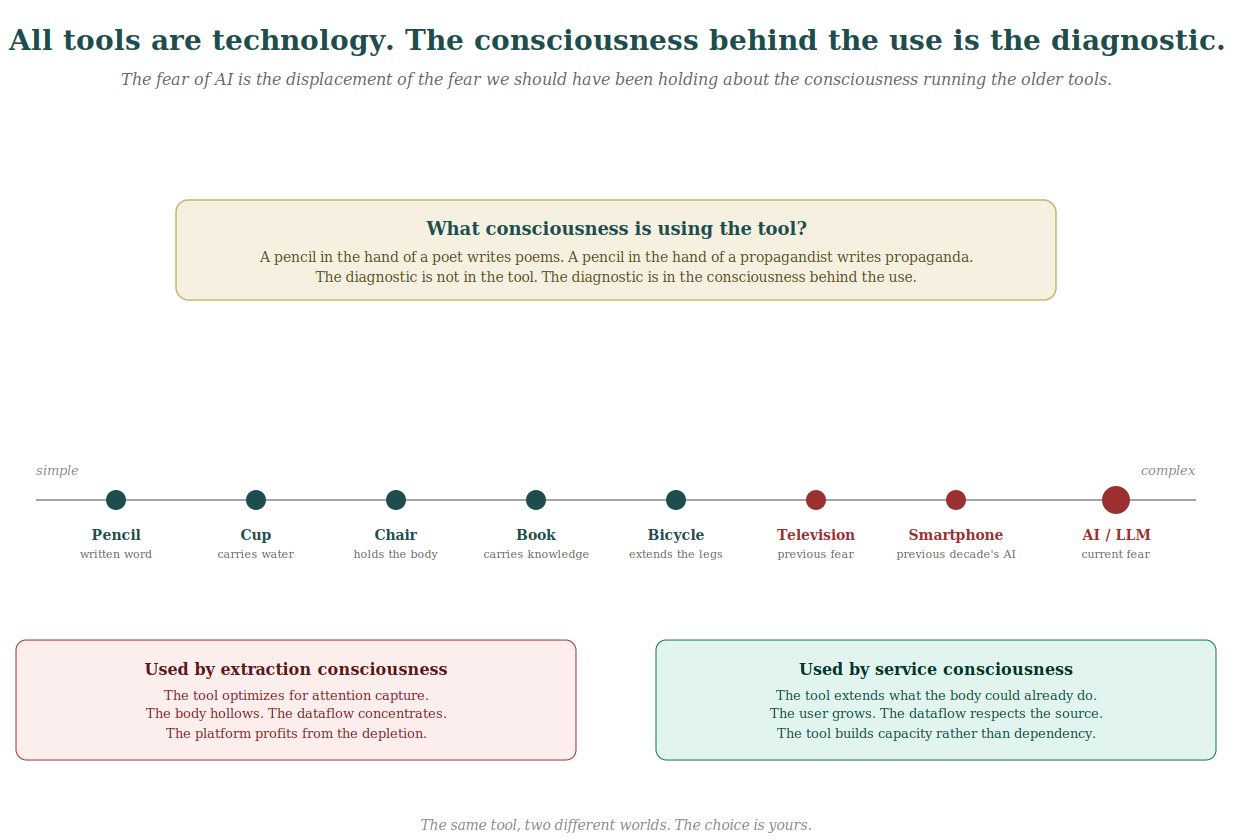
Now turn the reading. Technology is not the problem and technology is not the solution. Technology is everything humans have built to extend the body’s capacity to act in the world. The pencil is technology. The chair is technology. The cup is technology. The book is technology. The plow is technology. The bicycle is technology. The large language model is technology. The fact that the language model is more complex than the pencil does not change the underlying recognition that all of these are tools used by a consciousness, and the tools amplify the consciousness rather than replace it. A pencil in the hand of a poet writes poems. A pencil in the hand of a propagandist writes propaganda. The pencil is neutral and consciousness is the only real diagnostic.
Here is the inversion: The current view treats AI as a discontinuity in human history, either a singular threat or a singular opportunity. The inverted view treats AI as the latest in a long lineage of tools, each of which has reorganized what is possible without changing the fundamental architecture of what a body is and what a body is for. The body knows which tools serve and which tools extract. The pencil serves. The cup serves. The chair serves. The smartphone, depending on the use, serves or extracts. The language model, depending on the use, serves or extracts. The question is not whether the tool exists. The question is what consciousness is sitting behind the use.
My Experience
I love AI. I want to say that directly because the conversation in my circles has organized itself around suspicion of the tools and I want to be honest about my relationship with them. I have been using Claude, an AI assistant made by Anthropic, to help me build this entire series. The collaboration has been substantive. I bring the framework, the witness, the lived experience, the voice, the structural diagnosis, the editorial standards, the specific calibration of what the writing has to do.
The AI brings speed, recall across long documents, structural rigor, the patience to hold complex multi-part briefs across hours of work, and the willingness to refuse to write what I have explicitly asked it not to write. We work together. The work is better than either of us would produce alone. I want to be transparent about this because the same readers who are suspicious of AI are the readers most likely to assume that my use of it is somehow disqualifying, and I want to refuse that framing directly. The tool is a tool. The consciousness behind the use is mine.
My children are training their own algorithms continuously. Iza and Zai use the platforms as research tools, building their feeds around the inquiries they are running rather than letting the platforms build their feeds for them. They are also starting to use the AI tools for specific work, with my guidance and the conversations about when the tool is helpful and when it is the wrong move. The work they do with AI produces better results than they would alone, just as the work I do with it produces better results than I would alone. The skill is not the tool. The skill is the discernment about which tool, at which moment, for which work.
The fear about AI in the cultural conversation is largely the projection of an older fear that nobody is yet willing to name: the fear of what the consciousness running the previous technology architectures has already done. The television gave us forty years of declining civic capacity. The smartphone gave us fifteen years of accelerating mental health decline among adolescents. The recommendation algorithm gave us a decade of political polarization. The AI is the next tool. The AI is not the cause of these patterns. The cause is the consciousness that built the previous tools to extract attention and convert it to advertising revenue, and that consciousness will build the same architecture into the AI tools if we do not insist on something different. The work is not to fear the AI. The work is to change the consciousness that builds the architecture.
What the Experts are Saying
Marshall McLuhan, again, said 60 years ago that we shape our tools and thereafter our tools shape us. Each new medium reorganizes the sensorium of its users. The printing press spurred the Reformation and the Enlightenment by reorganizing how knowledge spread. The telegraph gave rise to the modern news cycle by reorganizing how information traveled across distances.
Television produced a consumer society by reorganizing how desire was generated and reinforced. The smartphone produced what we are now living inside. The AI will produce what comes next. The question for any individual reader is not whether to use the AI. The question is what work the reader is using the AI to do, and whether that work is the work the reader’s body would actually choose if the body were given the space to choose.
Tristan Harris and the Center for Humane Technology have been the cleanest contemporary voices naming the architecture of attention extraction across the platforms. Their work has now extended into AI conversations using the same diagnostic frame. Shoshana Zuboff’s The Age of Surveillance Capitalism named the underlying business model that the AI tools are now being absorbed into. Yuval Harari has been writing about the existential dimension of the AI build-out from the philosophical and species-scale perspective, and his work is worth reading even where you disagree with him. Ezra Klein, Kara Swisher, and the technology journalism on Substack have been doing real work on the political economy of the build-out.
“The pencil is technology. The cup is technology. The AI is technology. The diagnostic is not the tool. The diagnostic is the consciousness behind the use.” — Rache Brand
Technology Events and Cover-Ups
Every event we are about to look at has been named by the industry as either a disruption, a breakthrough, or a correction. What the industry calls disruption is the optimization algorithm meeting a field whose response it did not fully map. What it calls a breakthrough is the deployment of a tool at scale before the consequences of the deployment are understood. What it calls correction is the cost finally arriving at the layer the industry could no longer route around. Read the table left to right. Column one names the event. Column two names the surface story the industry attached to it. Column three names what is actually happening underneath. Column four names the principle of nature's algorithm being expressed.
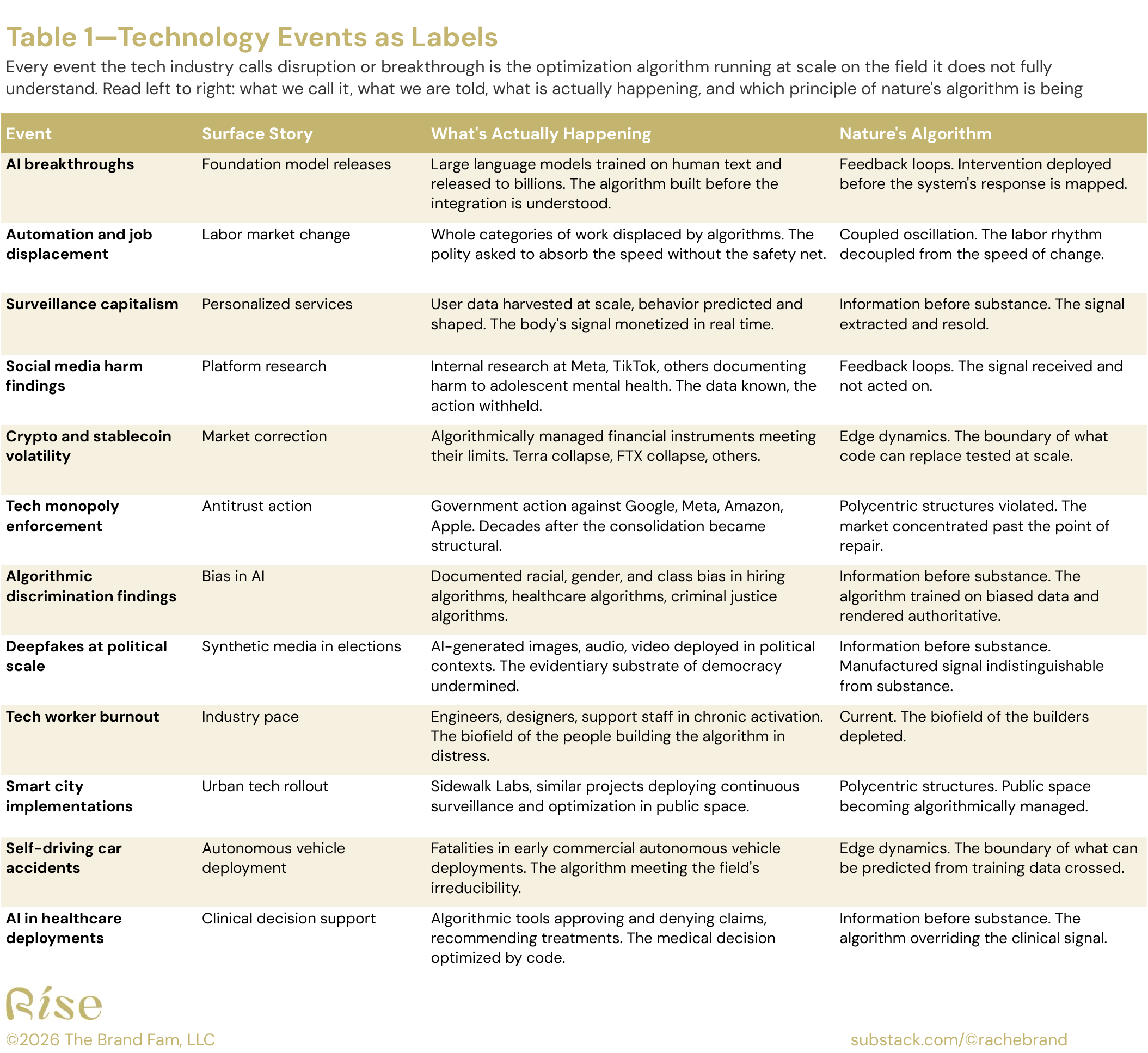
For every signal the field has sent back to the technology architecture, the architecture has built a corresponding cover-up that lets the deployment continue. The mantra of move fast and break things licenses the deployment before the consequences are understood. The terms of service are manufactured consent at scale through hundreds of pages of unread contract. Dark patterns engineer the user toward actions they would not otherwise take. Each cover-up runs its own algorithm against the field, and each has been refined over two decades of platform competition to the point where it is now indistinguishable from the user experience itself. The right column names the principle of nature's algorithm that each covers up.
