

Curiosity Club
Curiosity usually starts when we start to ask why. This club is for those who actually want to be curious in life and to explore and expand.

The questions you keep skipping over…
My friends, you are missing the good stuff!
This is the juicy and delicious stuff that really has meaning in this world.
Most of the time, we take those questions for granted as absolutes and just say, “Who knows?” These are the questions that surface every day, only to be dismissed because they feel inconvenient, strange, or a little too bizarre to even ask. Your inner thoughts would be revealed. OMG! But honestly, sometimes, they are the questions that surprise you simply because they exist.
Curiosity Club is an opportunity to give yourself permission to just ask.
Breathe into yourself, with your hand on your belly, and be present in the world, not letting any single question pass you by. In that moment, you are empowering yourself to be the master of your domain, to be in charge.
Movement matters. A 30–45 minute walk is the catalyst to get that blood flowing.
Then notice what shows up.
When the body moves, the mind loosens. Patterns soften. The nervous system settles just enough for quieter truths to surface. You’re no longer forcing insight—you’re creating the conditions for it.
Some questions to play with:
What did I just see that I’ve passed a hundred times before?
What do I think about regularly but never actually ask?
What surprised me today—and why?
What question keeps returning, even when I try to ignore it?
Just notice.
Curiosity will wait for space… so don’t try to rush yourself to ask. Just hold space and calm and then see what comes up.
Give it a try.
And if you want to go deeper, try forest bathing out. It’s magical:

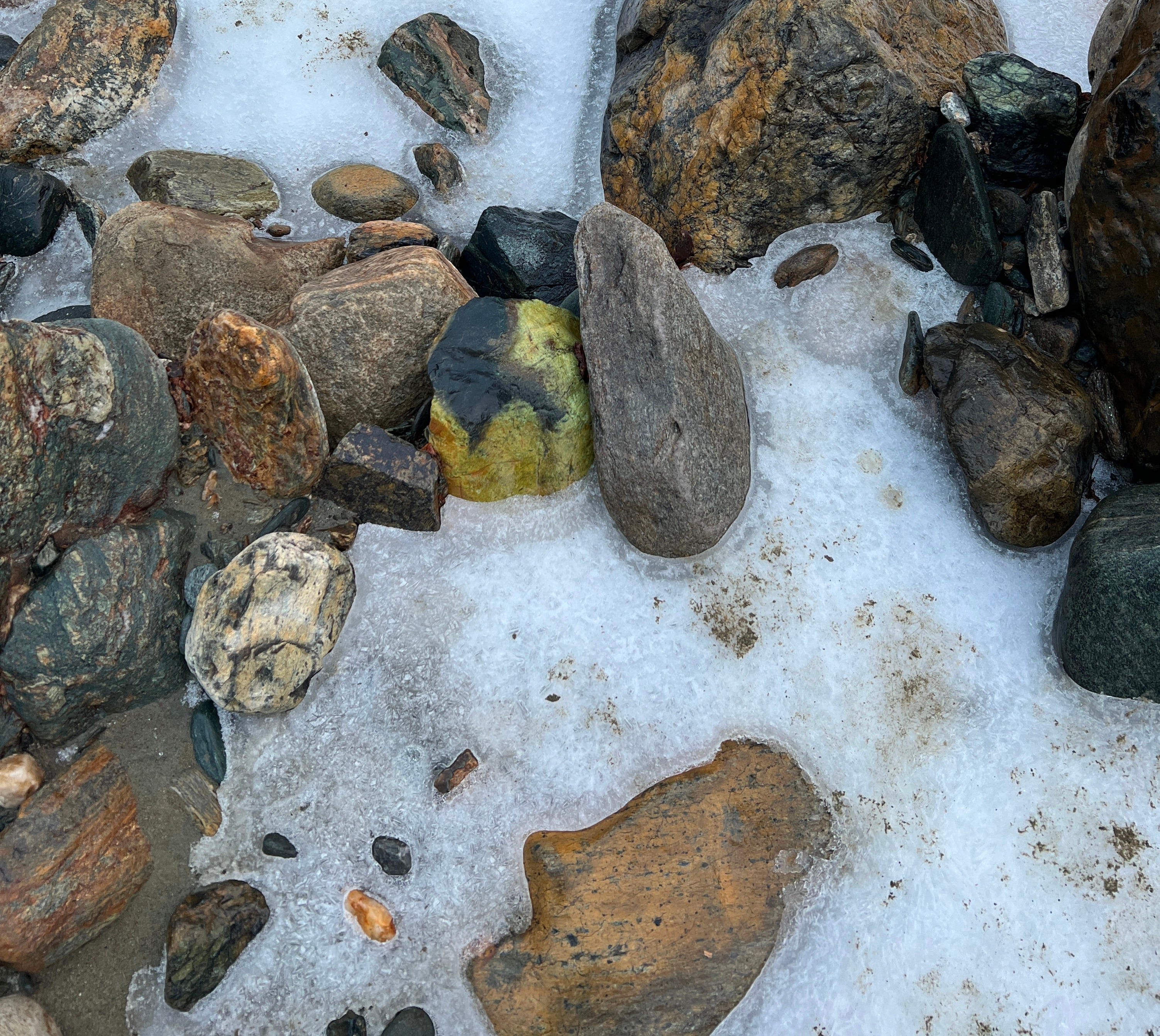
Curiosity Club Question: Why is there a gap between the rock and the ice? Is the rock warm? Does the material create friction?
Your Siblings are Your First Teachers
Listen. Pay Attention to What They Want You to Know.
When my brother Michael was little, he would ask a BAZILLION questions in the day. Some of my favorite ones to recall:
Why is the sky blue?
Why is a mailbox called a mailbox?
Why do we have to do that again?
It was SOOOO annoying. And also kind of interesting. He asked questions I would never have thought about, that I just didn’t even question. And because of Michael, I learned a lot and came to understand the importance of a curious mind. That mind is what has kept me semi-awake throughout my life… even when I was medicated, I still always knew something was off.
Why does my given name need to be my name?
Why do I need to live in America?
Why do I have to be old to start a company?
Why do I have to make money?
Why can’t I buy a house at 20 and get married?
Why can’t I move to Latin America with a baby?
Why can’t I work in finance with an art degree?
Why is electricity the only option?
Why can’t I homeschool my kids?
Why do we have school in the first place?
And it became the story of my life, asking big questions and moving in a different direction. One who was not convinced that what we had was right.
Actually, I have been trying to figure out since I was 3 years old why every adult I knew was unhappy and held so much pain and suffering in their bodies and faces. Fear.
But more of that later.
The Real A-ha Doesn’t Happen When You Get the Curiosity Itch Scratched
It happens when curiosity pulls you far enough that you want to explore the throughline of all things.
Iza started with a simple question about the human body: how it actually grows, not just that it does. That question didn’t stop there. It led her to animals. Then patterns. Then biology.
She learned that alligators keep growing and regularly shed layers of their skin as their bodies expand. That lobsters grow inside a rigid shell until it becomes a limitation, then shed it entirely. They enter a brief, fragile phase with a soft shell before it hardens again, one of the reasons lobsters can live close to a hundred years.
We noticed the same thing happening on our plants. When a new leaf emerges, it’s thin, soft, and extremely vulnerable. Over time, structure forms. Strength comes later.
That’s when the question shifted…. from what grows to how growth actually works.
And that led us straight into cellular biology and what cells are doing in those moments of expansion, exposure, and rebuilding.
The pattern is growth through exposure and vulnerability.
Across biology, growth doesn’t happen by adding layers on top of what’s already rigid. It happens by outgrowing an existing structure, temporarily losing protection, and then rebuilding stronger. So, actually, our growth is from becoming ready for the next stage.
Lobsters grow by molting. Their cells divide and expand inside a rigid shell until the shell becomes a constraint. They shed it, enter a soft, exposed phase, and then rebuild a larger shell. During that window, they are highly vulnerable—but without it, growth would stop. This repeated cellular process is one reason lobsters can live exceptionally long lives.
Alligators continuously grow and shed outer layers of skin as their tissues expand. The shedding allows regeneration and prevents constraint as the body increases in size.
New plant leaves emerge soft, thin, and highly sensitive. The cells are rapidly dividing and elongating, with minimal structural reinforcement. Over time, cellulose thickens, cuticles form, and the leaf becomes resilient. Early vulnerability is not a flaw—it’s a prerequisite for expansion.
At the cellular level, this moment is driven by:
Cell division (mitosis)
Cell differentiation (cells taking on specific roles)
Temporary reduction in structural rigidity to allow expansion
Subsequent reinforcement (proteins, membranes, structural fibers)
The key insight:
Growth requires a temporary loss of protection.
Biology doesn’t optimize for constant safety. It optimizes for adaptation.
When systems—cells, organisms, ecosystems—become too rigid, growth stalls. When they allow controlled vulnerability, they evolve.
That’s the real a-ha: Vulnerability isn’t weakness in nature.
It’s the active phase of becoming larger, stronger, and more complex.
For me as a mom there is SO MUCH MORE to unpack from that statement, but for my beautiful 12-year old, that’s a pretty cool learning to start.
Feel free to ask questions! Reach out.
Few examples from this month:
Curiosity Club
What Are You Curious About? (Perception & Systems)

Week 1
Curiosity doesn’t start with answers.
It starts with the questions you keep circling but haven’t said out loud yet.
Before we begin, name one real question you’re already asking, but you didn’t quite know the answer to?
Here are some examples from Iza to help you think about it:
Why does Willow lick her paw and then clean her ear?
How do tumors develop?
Why are squirrels so annoying?
How is the human body constantly changing shape?
There’s no wrong question. Ask away.
Movement First
Take a 30–45 minute walk.
No podcast. No agenda. Just movement.
Notice what your mind returns to when it isn’t being directed.
Here are some other prompts to always think about:
What does the sun do to the shadows today?
Does my face feel cold or warm?
What does the ground feel like under my feet?
How does the air move around my body when I move?
What do I feel in this moment?
What did I notice that I hadn’t noticed before?
Jot Down Some Observations
Color of the leaves or the ground
The way the light moved
Time of day
How your body felt
What you heard from the wind, the birds, the sounds around you.
Now what Questions arose?
How come the cold temperature made a bigger space around the rock this time with the snow?
How come my face almost felt like it was stinging from the cold air on it?
Why was that bird calling out in that particular pattern?
No question is silly; reach out to me if you have anything that comes up.
Curiosity Club Prompt
Option 1: Optical Illusions

Science Lens
Optical illusions happen because vision is not a camera. The brain predicts what it expects to see and fills in the gaps using shortcuts, context, and prior experience. Most visual processing happens in the visual cortex (V1–V5), but perception is shaped just as much by memory and expectation as by the eyes themselves.
Why This Matters
Illusions show us that perception favors efficiency over accuracy. The brain chooses speed, energy conservation, and pattern recognition—even if that means distorting reality.
Key Mechanisms
Top-down processing (expectation shaping perception)
Lateral inhibition (contrast exaggeration)
Depth and perspective bias
Motion detection errors
Contextual priming
Explore Nature
Out in nature look at the illusions that you see around you
What is hiding just below the surface?
What is present in front of you?
Flip your head upside down, what do you see?
Look up Online
Why the Müller-Lyer illusion changes perceived line length
Why static images can trigger motion-detecting neurons
How color contrast alters brightness perception
Curiosity Question (choose one)
If the brain alters reality to conserve energy, how often do we mistake efficiency for truth in everyday life?
Add to Curiosity List (Required)
What’s the difference between seeing something clearly and understanding it accurately?
Curiosity Club Prompt
Option 2: Surveillance Systems
Systems Lens
Surveillance systems are networks that collect data, recognize patterns, and predict behavior. They use cameras, sensors, metadata, and machine-learning models to monitor and anticipate activity.
Why This Matters
Surveillance doesn’t just observe behavior—it changes it. When people know they’re being watched, decision-making, creativity, and risk tolerance shift.
Key Components
Computer vision (object and facial recognition)
Pattern recognition and anomaly detection
Data aggregation and feedback loops
Behavioral prediction models
Bias amplification from training data
Explore in Nature
Sit quietly for 20 minutes… what changes in the space around you? What new animals do you hear or see?
Watch your cat watch the birds for 10 minutes. What is the bird doing?
What does life look like?
Look Up Online
How facial recognition accuracy varies by lighting and skin tone
How constant observation impacts stress and neural load
Where prediction fails when context is removed
Curiosity Question (choose one)
At what point does observation stop protecting a system and start controlling it?
Add to Curiosity List (Required)
How does being watched change who we become—even if no one intervenes?
Examples from our school program
Rules, Nature, and Self-Authority
January 15–20
1/15 — Signal from Nature
Question: How does nature correct imbalance?
Look for examples:
Overgrowth and pruning
Predator–prey dynamics
Forest fires and regeneration
Optional creative bridge:
What in Pokémon resembles a real biological or ecological system?
Write one paragraph connecting the fictional system to a real natural pattern.
1/16 — Walking Inquiry
Prompt:
Where do rules help me? Where do they limit me?
Think about this on your hike.
Don’t solve it. Let examples surface.
Write when you get back.
A starting reflection from Iza that should inspire. We are reading The Giver:
Rules exist to reduce harm and create safety. But sometimes they do too much and then we don’t hear ourselves anymore.
1/20 — Reflection
Question:
What rules does nature follow without authority?
Nature doesn’t enforce rules, it responds to conditions.
Gravity doesn’t punish—it acts.
Bodies don’t moralize imbalance—they signal it.
Ecosystems don’t argue—they recalibrate.
Close with this:
Which rules in my life are responsive—and which ones exist only because someone said so?
Share what you are working on!
Wow I cannot wait to try these!