

Decode: Nature as Medicine (Forest Bathing)
Nature is an essential part of our life and we have stopped spending time in it. We forget it's importance, but more importantly we are dysregulated because we are not meeting our needs.

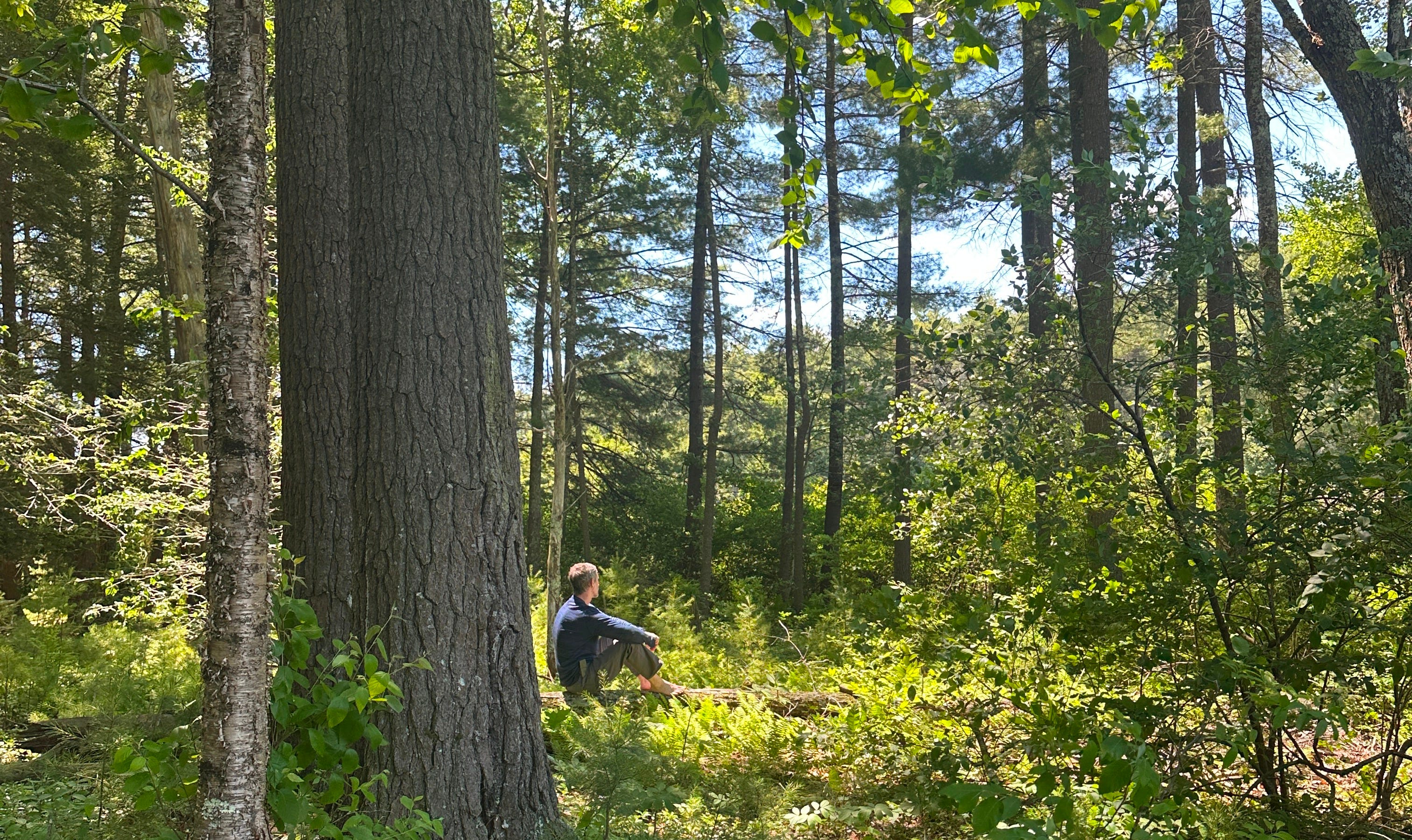
“In every walk with Nature one receives far more than he seeks.”
—John Muir
Forest Bathing is Missing Medicine
I came to Connecticut for the trees. Two years ago, at a dinner for the Simsbury Land Trust, a woman from Austria sat at my table, a retired librarian in her late seventies, there with her boyfriend in his eighties. She told me she’d come to Simsbury for the trees. I looked at her and smiled, and I realized in that moment, Me too. Actually, I came here specifically for the trees, for the forest.
Our house sits on 3-acres with a pond with a diverse lifecycle and ecosystem that backs up to an enormous estuary and native marshland. Sometimes it is a pond, sometimes it is a 5-acre mudpit. Both are beautiful and unique in their own way, but our trees are next level. I look at them every night when I take Kirra out. Some are over 100 ft. tall and I have honestly never in my life seen trees that I connect to like this.
I am in the woods every single day, actually, I think of it more like I live in the woods, and I happen to have a boundary line with 4” of wood and glass that keeps me in a cell separate from it. After reading Anastasia, I realize we have tricked our bodies into believing we are separate from nature, and that this beautiful woman lives in the Siberian Highlands, in the Taiga, without a structure, and her body adapts to the temperatures of the seasons.
Sunday, at the Cattail Gathering for Father’s Day, we spent the morning in the trees doing a forest bathing exercise. We lay on the ground for a corpse meditation, stood rooted for a tree meditation, the practice hosted by Gaian Way’s Erik Assadourian calls a way to “exist at the scale of a tree.” I came out of the time together slower, clearer, and in no rush to move through the day. And the truest part came at the edge of my own field, where I slipped my shoes off and just made peace with the 2.5 hours of energy placed in the form of connection with the earth, and my family. I know when I need to set ‘something down,’ one step onto bare earth does it for me. The second my skin hits the dirt, I’m home again.
Forest bathing, or shinrin-yoku, is woven right into Japanese healthcare to support mental and physical wellbeing. Time in nature has been shown again and again to lower blood pressure, ease stress, and boost the immune response. Erik’s class walked us through a set of nature-connection and mindfulness exercises focused on awareness, breath, and movement.
The Gaian Way, an ecospiritual organization built to reconnect people to the living Earth we’re part of and depend on. Erik’s also a sustainability researcher and writer who studies how we turn consumer cultures into cultures of sustainability, and he spent seventeen years at the Worldwatch Institute, where he directed or contributed to well over a dozen books. He leads a monthly forest bathing class in Middletown, Connecticut, and he is moving to West Hartford, and I am hoping he chooses to do one here too. As he puts it, “we are very much part of Gaia, not the other way around.”
Shinrin-yoku, or forest bathing, was coined in 1982 by Tomohide Akiyama, then the head of Japan’s Ministry of Agriculture, Forestry and Fisheries. It came as an answer to a country working itself sick, the era that gave us the word karoshi, death by overwork. Akiyama gave it two jobs at once. Send people into the forest for their health, and let that health teach them to protect the forest. The reverence underneath it goes back much further. Shinto holds the forest as the home of kami, and the satoyama tradition keeps land in balance between wild and tended. The feeling is as if we have stepped back in time and placed ourselves exactly where we were supposed to be before the Inversion took over.
The practice for many of us Americans is new… and it’s an invitation to relearn and remember our own unique gifts, purpose and why we are here.
What Is Missing from Our Understanding
Most of us file the forest under scenery or resources, and as an activity we get to enjoy on the weekend. I did too for all of my life before Connecticut. I find it hard to write that statement because if I knew then what I know now, I would have made the change a lot sooner. And many of you do not experience what I experience every day. You might visit it, photograph it, harvest from it, and leave as I did. In this case, you are not giving back or enjoying every piece of the expression it can truly offer and boy o boy are you missing out. I was too. Nature wants you to be ‘in it’ with its daily existence.
The part our models skip in health & wellness in this Inversion life is that our bodies read the forest as information and regulate in response to it. The science and data on this is real, but there is not a ton of data on it. Actually, that open part is the part I love most. An idea that isn’t a required, step-by-step prescription, just the guidelines and the invitation, and then it’s yours to go explore. Nature does not really have hazards, although we like to think it does and we blow it WAY out of proportion, like the mosquito or the bear, the tick, those are just fear centers illuminating.
I’ll write a whole post on this soon, but even the bugs are essential to our well-being. When you get pricked, it is a chance just like a tattoo of ink in your skin to heal from it. It makes you more resilient, but more importantly, it cleans you out. Zai had Lyme disease. Actually, he was told he had chronic Lyme. Instead of worrying about it, I doubled down on nature and let it heal him from the inside out. And it worked. He’s outside every single day. He gets ticks all the time; they rarely bite him, he’s had no flare-ups, and his bloodwork no longer shows Lyme. I can’t prove nature did it, and I’d never tell you to skip your own doctor, but I know what I watched happen with my kid. Even I get ticks. I had a tick in my back yesterday, not all the way in, though it took a nice chunk of me when I pulled it out. I thanked the little guy for his gift and sent him on his way. I get bit three or four times a week, and Lyme still hasn’t found me.
The honest position is simpler. We are nature. That’s it. Step out of it, and we live in simulations of it, until we let ourselves come home.
Shinrin-yoku is slow, senses-open time inside a forest. You walk with no destination, put the phone down, and let your eyes, ears, nose, and skin do the work. For a long time the forest looked like the backdrop to the real event. It only looked that way. The forest is the event, the thing your nervous system tunes itself against.
The forest is the actual expression of the medicine your body needs before your mind catches up to understanding what it is missing. This is why often we feel ‘sick’ and we just don’t know why. Did you ever feel so tense you were just going to explode? Did you then go into nature and maybe take a rigorous hike or a nice long stroll and you suddenly feel like the anger actually breaks? My understanding of how this works is that you will just FEEL into nature's expression and it will help you to release what you are holding onto.
How It Works
Remember, we’re all in the same Biofield. We each carry our own Sorce field, and we move through other fields too, with our people and our work, and the balance between all of them is what keeps us alive. Two things matter most here, the air and the breath.
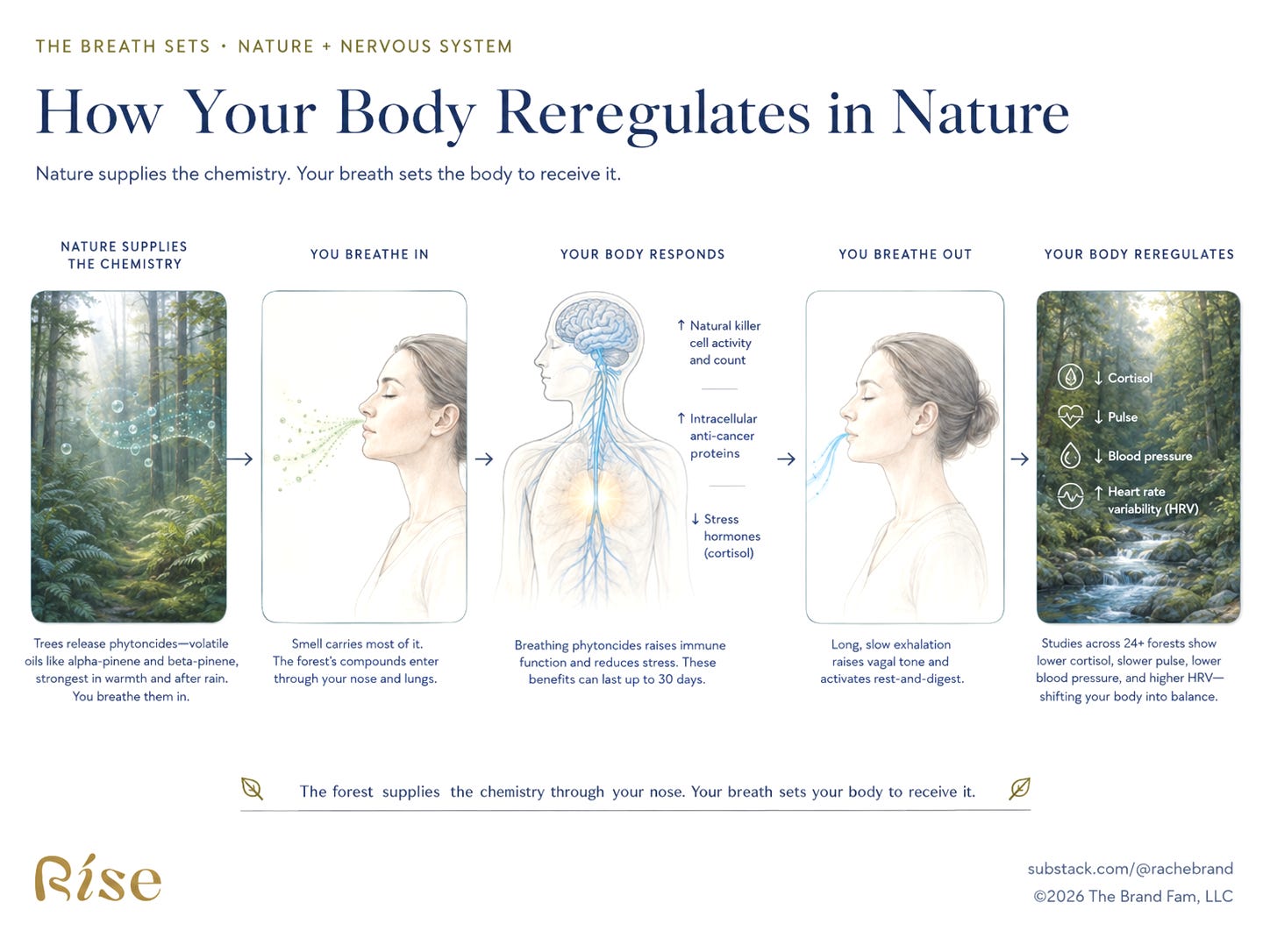
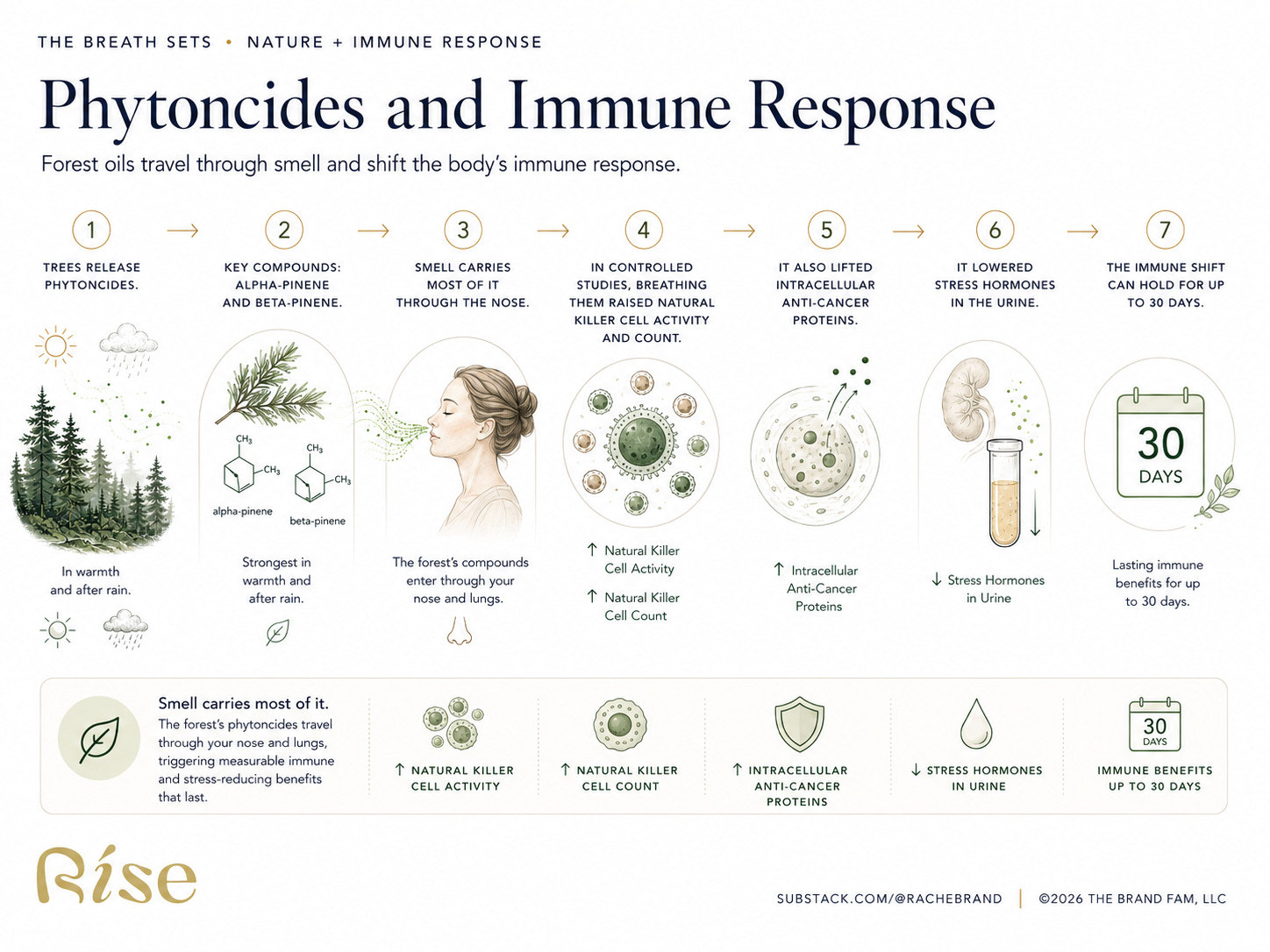
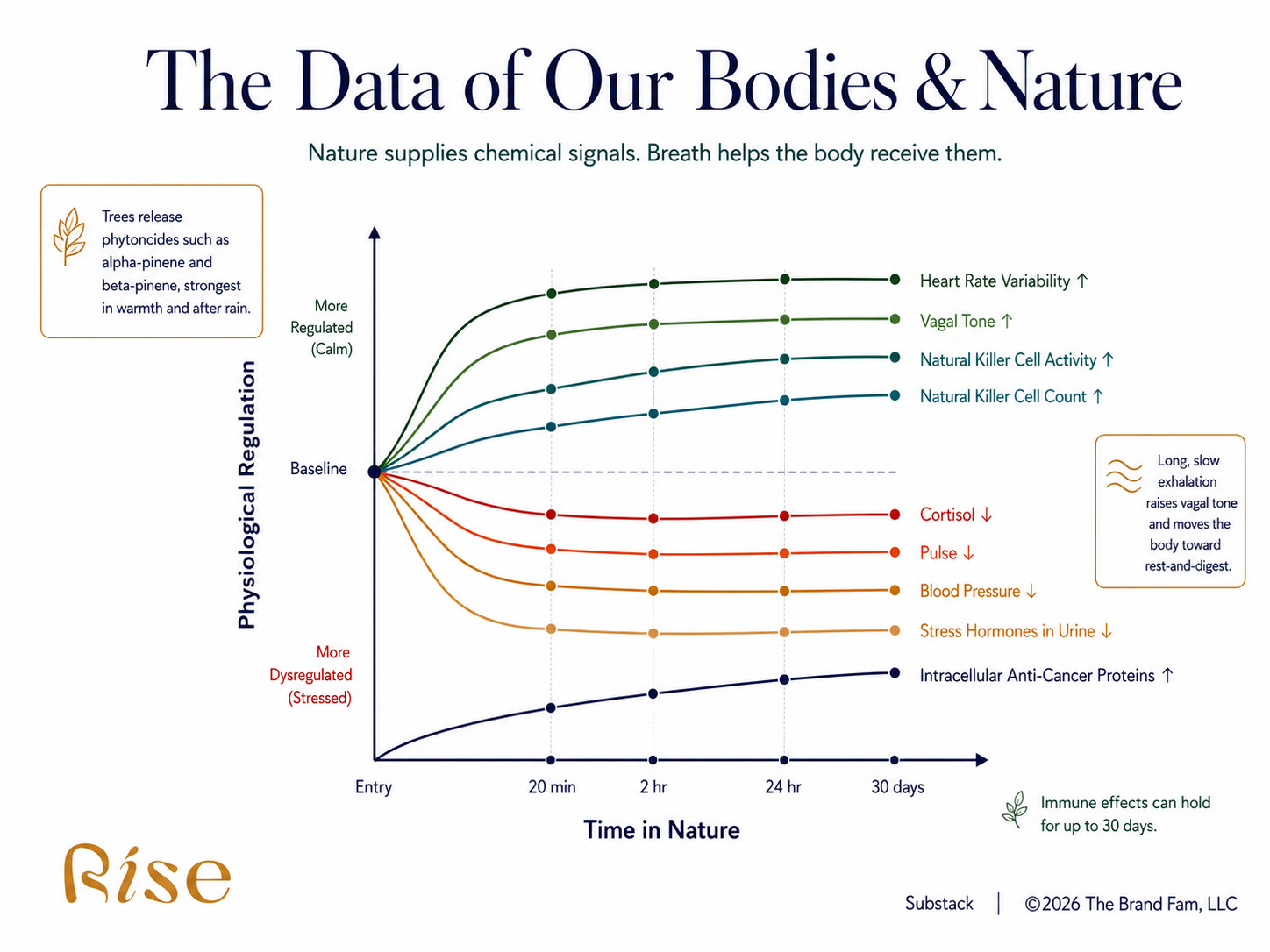
The first is the air. Trees release phytoncides, volatile oils like alpha-pinene and beta-pinene, strongest in warmth and after rain. In controlled studies, breathing them in raised natural killer cell activity and count, lifted intracellular anti-cancer proteins, and dropped the stress hormones in your urine, and the shift held for up to thirty days. That’s right. You go into nature once and your chemistry stays shifted for thirty. Pretty great ROI. The smell carries most of it.
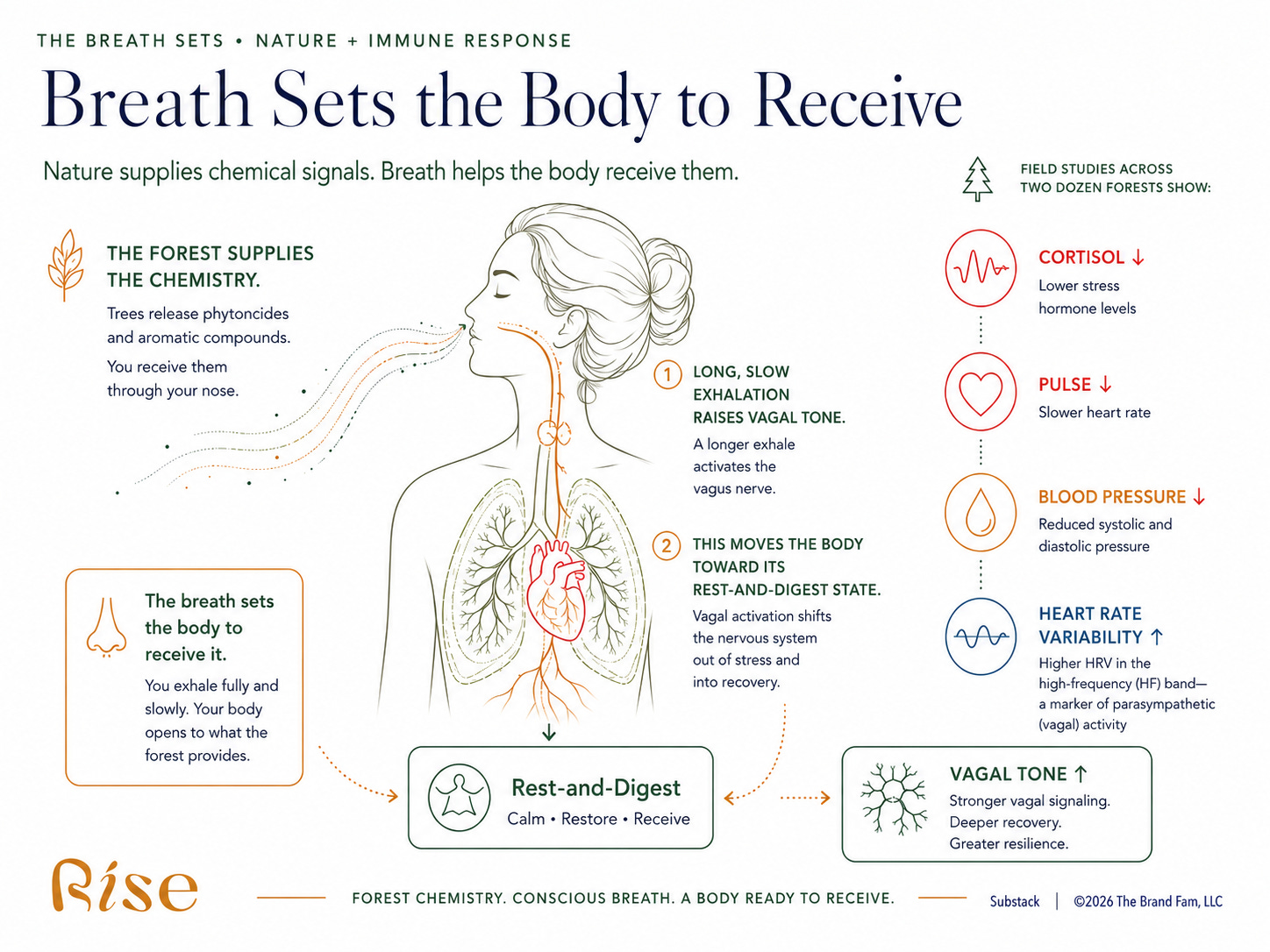
The second is the breath. A long, slow exhale raises vagal tone and moves your body into rest-and-digest. Studies across two dozen forests show lower cortisol, slower pulse, lower blood pressure, and a rise in the heart-rate-variability band that tracks the parasympathetic system. The forest hands you the chemistry through your nose. Your breath decides how much of it lands.
And if you want to see it as data, this is what your body does, minute by minute, and then for weeks after you leave. The forest carries the medicine in the air. Your breath decides how much of it you actually take in.
Time in a forest moves the body in two directions at once. The stress side comes down, with lower cortisol, slower pulse, lower blood pressure, and less adrenaline and noradrenaline, while the restoration side comes up, with higher heart rate variability and stronger vagal tone. The autonomic shifts arrive fast, inside about fifteen to twenty minutes, and run on the breath and the slowed nervous system. The immune shifts take longer exposure and run on phytoncides, the airborne oils that trees give off, which raise natural killer cell activity and count along with intracellular anti-cancer proteins. That immune lift can hold for days, and up to about thirty in one study, which is where the thirty-day line comes from.
The evidence sits with two Japanese research groups. Qing Li at Nippon Medical School built the immune and phytoncide case across studies from 2006 to 2009, including a hotel-room experiment that piped cypress oil into the air and reproduced the immune shift with no forest present. Bum-Jin Park, Yoshifumi Miyazaki and colleagues at Chiba University built the autonomic case, anchored by a 2010 field study across twenty-four forests that produced the cortisol, pulse, blood pressure, and parasympathetic findings. Later reviews and meta-analyses pooled this work and landed on the same direction.
A Field, Closed
Zai is barefoot so often that I have to remind him to bring shoes if we’re heading into town. I used to keep a pair in the car, but between the ones he never wore and the sweaty, wet ones he’d leave behind, they eventually got cleared out.
After the diagnosis, we did some energy work, I’ll write about another time, what I think of as closing his field, and he hasn’t been sick in the two years since. I put his health down to his life outside and his love for every living thing. He’ll stop and pour his whole self into whatever’s around him. He’ll find the sweetest little creature, or swish his toes all the way into the mud. Nothing in my house is clean, and I’m completely fine with it, because this kid is living the dream.
Our Sorce Fields remain open until we learn how to work with our energy. Chinese Qi helps us identify energy centers that are blocked and those that are receptive to external influences. Zai has been able to open his energy field to nature and keep it in reciprocity. He did this naturally, without force, but as he moved into this power center, it changed how he connected to everything. It’s not something I can prove in science, but I know it has worked for his healing.
It Only Takes 2-Hours to Transform Your Life
Erik walked us through this incredible arc. A connection to our own tree, the breath, the feeling of growing the way a tree does, and then a barefoot walk through the woods, where I realized the only time my feet actually hurt was where man had stepped in, the death. The one I loved above everything else was the feeling of nature on my feet, half-painful and half-full of love, a reminder that pain is part of growing. I loved the swishy wet moss under my toes, and the leaves that kept catching in between. I loved skipping across a line of tree-grove stumps. It was magical. The Sit Spot was the best of all, the same thing my kids do all the time at camp. I just sat and looked out over the swamp, all those layers of ecosystem and life working together. The video above is from my Sit Spot.
We each got to have a conversation with a tree. I really got into mine, took a photo with it, and imagined how strong and sturdy it must have been across its whole life. This is the experience that reminded me that each living organism has a role in my life. If I connect with it, I am forever changed. This is the idea of something entering your field and being in an energetic exchange with it, just like your mirror.


Activity: Nine Breaths, Alone or with Your Friends, Kids, or Partner
With thanks to the Gaian Way, from which I adapted this version.
Find a few trees and give them twenty minutes.
Leave the phone in your pocket.
If you feel called to, and I’d recommend it, take your shoes off and let your feet make real contact with the earth. Feel into it.
Breathe in deep, then draw out a long, slow exhale. Empty all the way, then pause and reflect. Do this nine times, and keep the rounds slow.
On the last of each exhale, let your attention widen by one ring:
Start with just your heart.
Then your body.
Then the space around you, the ground, the trees, the air moving through all of it.
Then out past the forest, to the community around you, and breathe.
Then your city, with gratitude for your home, the trees you may have planted with your kids, the bed you get to sleep in, your plants, your neighbors.
Then your country.
Then your part of the world, where you share weather and language and resources.
Then the parts of the world you don’t live in, the differences that have helped your own practice along.
And finally the universe, the last breath of the whole thing, the stars and the moon and the planets next door and the Milky Way, the forces that move the tides.
Open your eyes slowly, and notice how long the quiet holds before you have to move. Walk back through the whole thing, and don’t rush to do anything except be in it.
The dose is small. Twenty minutes, nine breaths. And your body keeps feeling it long after you’ve left.
Forest bathing is a reminder that we get to receive as much as we give. It’s a yin practice. A way to be connected, to take in a little wisdom, and to remember that nature is always calling us, and we’re usually just too busy to hear it.
With Love,
Rache
🤍
References
Practices
Corpse Meditation. Gaian Way.
Be a Tree. Erik Assadourian, Gaian Way.
Nine Breaths with Gaia. Bart Everson, Gaian Way.
Research
Shinrin-yoku was coined in 1982 by Tomohide Akiyama at the Japanese Ministry of Agriculture, Forestry and Fisheries.
Qing Li and colleagues. Phytoncides and human natural killer cell activity. 2006 and 2009.
Bum-Jin Park, Yuko Tsunetsugu, Yoshifumi Miyazaki and colleagues. Field experiments on the physiological effects of shinrin-yoku across twenty-four forests in Japan. 2010.
Juyoung Lee, Bum-Jin Park, Yoshifumi Miyazaki and colleagues. Effects of forest bathing on physiological and psychological responses. 2011.
Erik Assadourian, interview with the Millennium Alliance for Humanity and the Biosphere (MAHB), 2022.
The Immune / Phytoncide (Qing Li, Nippon Medical School, Tokyo)
Li Q. et al. (2006). Phytoncides (wood essential oils) induce human natural killer cell activity. Immunopharmacology and Immunotoxicology.
Li Q. et al. (2008). Visiting a forest, but not a city, increases human natural killer activity and expression of anti-cancer proteins. International Journal of Immunopathology and Pharmacology.
Li Q. et al. (2008). A forest bathing trip increases NK activity and anti-cancer proteins in female subjects. J. Biological Regulators and Homeostatic Agents.
Li Q. et al. (2009). Effect of phytoncide from trees on human NK cell function. Int. J. Immunopathol. Pharmacol. This is the hotel-room study that piped hinoki cypress oil into the air and reproduced the immune shift without a forest, which is the strongest evidence that the oils themselves are doing it.
The Autonomic / Stress Line (Bum-Jin Park, Yoshifumi Miyazaki and colleagues, Chiba University)
Park B.J., Tsunetsugu Y., Kasetani T., Kagawa T., Miyazaki Y. (2010). The physiological effects of shinrin-yoku: evidence from field experiments in 24 forests across Japan. Environmental Health and Preventive Medicine. This is the source for the cortisol, pulse, blood pressure and parasympathetic findings, and for the percentage figures above.
Lee J., Park B.J., Tsunetsugu Y., Ohira T., Kagawa T., Miyazaki Y. (2011). Effect of forest bathing on physiological and psychological responses in young Japanese male subjects. Public Health.
Reviews & Meta-Analyses
Antonelli M. et al. (2019). Effects of forest bathing on cortisol: a systematic review and meta-analysis.
Hansen, Jones, Tocchini (2017). Shinrin-yoku and forest therapy: a state-of-the-art review.
A 2024 systematic review and meta-analysis on phytoncides and immune function pooled this work and reached the same direction.